

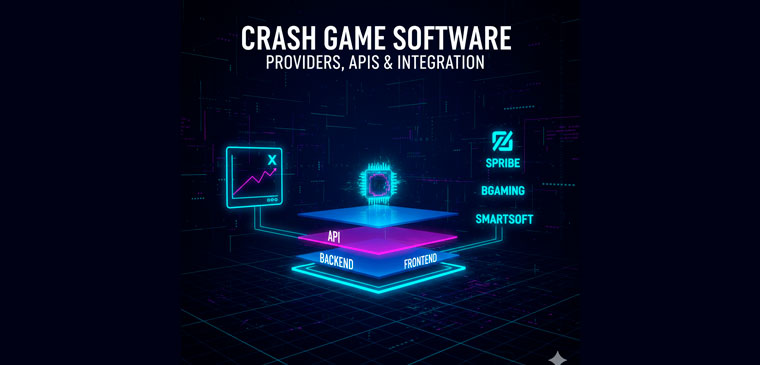
Every crash game you play — Aviator, JetX, Space XY — was built by a specialized software company and delivered to the casino through an API. The casino didn’t create the game. It licensed the software, connected to the provider’s system, and embedded the game on its site. Understanding this pipeline matters because it determines what RTP you’re actually playing at, whether the game is genuinely Provably Fair, and why the same game can behave differently across different casinos.
This guide breaks down the full crash game software stack: who builds these games, how casinos integrate them, what aggregator platforms do, and what it actually costs to launch a crash game on an online casino. Whether you’re a player trying to understand why Aviator pays differently at two casinos, or someone curious about the business behind crash games, this is the technical map.
How Crash Game Software Works: The Three Layers
A crash game is not a single piece of software. It’s a system with three distinct layers that work together in real time.
Layer 1: Game Logic (Backend)
The backend is where the crash point is generated. This is the mathematical core of every crash game — the algorithm that determines when the multiplier stops. In Provably Fair games, this involves server seeds, client seeds, SHA-256 hashing, and a hash-to-multiplier conversion formula. In certified RNG games (like Pragmatic Play’s Spaceman), the random number is generated by a tested and audited RNG module. The backend also manages bet processing, wallet transactions, and game state. When a player clicks “Cash Out,” the request goes to this layer, which checks the current multiplier against the crash point and either pays or denies the bet — all within milliseconds.
Layer 2: Frontend (Client)
The frontend is the HTML5 interface players see in their browser. This includes the multiplier animation (the rising curve or flying plane), the cashout button, the bet history, and the live feed showing other players’ bets. All crash games today are built in HTML5, meaning they run directly in the browser with no download required — desktop, mobile, and tablet. The quality of the frontend matters more than it seems. Network latency between your device and the game server introduces a delay between clicking “Cash Out” and the server processing it. Some providers like Spribe offer an option to disable animations to reduce this lag. Turbo Games even displays your estimated latency and warns you to use auto-cashout if it’s too high.
Layer 3: Integration API
The API is how the game connects to the casino. It handles communication between the provider’s game server and the casino’s platform — player authentication, balance updates, bet placement, and result reporting. Most providers use a “seamless wallet” model: when a player bets $5, the casino’s wallet is debited in real time via the API. When they cash out at 2.5x, $12.50 is credited back. The casino never has to build or maintain the game logic itself. It just connects to the API and the game appears on the site.
| Layer | Function | Who Builds It | Player Impact |
|---|---|---|---|
| Backend (Game Logic) | Crash point generation, RNG/Provably Fair, bet processing | Game provider (Spribe, SmartSoft, etc.) | Determines RTP, house edge, max multiplier |
| Frontend (Client) | Multiplier animation, UI, cashout button, live bet feed | Game provider | Affects latency, usability, mobile experience |
| Integration API | Wallet sync, authentication, reporting, bonus triggers | Provider + aggregator | Determines which casinos can offer the game |
Who Builds Crash Games: Major Software Providers
The crash game market is concentrated among a handful of specialized providers. Each has a different approach to fairness, RTP configuration, and game design. Here’s how they compare on the metrics that actually matter to players.
| Provider | Flagship Game | RTP | Max Multiplier | Provably Fair | RTP Configurable? | Founded |
|---|---|---|---|---|---|---|
| Spribe | Aviator | 97%* | 100x | ✅ Yes | ⚠️ Yes (94/96/97%) | 2018 |
| SmartSoft Gaming | JetX | 97% | 25,000x | ❌ Certified RNG | Unknown | 2015 |
| BGaming | Space XY / Crash | 99% | 1,000,000x | ✅ Yes | ❌ Fixed | 2018 |
| Pragmatic Play | Spaceman | 96.5% | 5,000x | ❌ Certified RNG | Unknown | 2015 |
| Turbo Games | Crash X | 97% | 999,999x | ✅ Yes | Unknown | 2020 |
| Evolution | Cash or Crash | 99.59% | 50x | ❌ Certified RNG | ❌ Fixed | 2006 |
| Onlyplay | Lucky Crumbling | 96% | 1,000x | ✅ Yes | Unknown | 2019 |
| Hacksaw Gaming | Speed Crash | 95% | 100,000x | ❌ Certified RNG | Unknown | 2018 |
*Spribe’s Aviator default RTP is 97%, but operators can configure it to 96% or 94%. Always check the RTP inside the game’s info/help menu.
The Configurable RTP Problem
This is one of the most important things to understand about crash game software. Some providers give casino operators the ability to choose the RTP. Spribe’s Aviator is the most prominent example: the default is 97%, but a casino can set it to 96% or even 94%. That’s a big difference — at $1/bet and 100 bets/hour, the hourly cost jumps from $3 to $6. You’d never know unless you check the game info panel. BGaming takes the opposite approach: their Crash game is locked at 99% RTP. The casino cannot change it. This is better for players because it removes uncertainty. For a deep dive into what these numbers mean in real money, see our RTP and house edge comparison.
In-House “Originals” — When the Casino Is the Provider
Some casinos build their own crash games instead of licensing from third-party providers. Stake created its own Crash with 99% RTP. BC.Game developed multiple originals including Classic Crash (99% RTP) and Trenball. Duel built a crash game with 0% house edge within daily limits. These “Originals” are typically Provably Fair and often have the best RTP in the market — because the casino controls the full stack and uses the game as a player acquisition tool rather than a revenue center. The tradeoff: you can only play them at that specific casino, and the game isn’t independently audited by a third-party lab.
How Casinos Get Crash Games: Aggregator Platforms
Most online casinos don’t integrate directly with each game provider. Instead, they use a game aggregator — a platform that bundles hundreds of games from dozens of providers into a single API connection. Here’s the simplified flow:
Casino → connects to → Aggregator API → which connects to → Spribe, SmartSoft, BGaming, Pragmatic Play…
Result: One integration = access to all crash games from all providers
Major Crash Game Aggregators
| Aggregator | Total Games | Providers | Notable Crash Providers | Integration Time |
|---|---|---|---|---|
| SOFTSWISS | 16,000+ | 200+ | Spribe, BGaming, SmartSoft, Turbo Games | 4–8 weeks |
| Hub88 | 12,000+ | 150+ | Spribe, Hacksaw, Pragmatic Play | 2–4 weeks |
| SoftGamings | 15,000+ | 200+ | Spribe, SmartSoft, iMoon, InOut | 2–6 weeks |
| St8 | N/A | Multiple | Spribe, Gaming Corps, Aviatrix | Days to 4 weeks |
| EveryMatrix | 15,000+ | 200+ | Spribe, BGaming, Pragmatic Play | 4–8 weeks |
Why Aggregators Matter for Players
When a casino uses an aggregator, the aggregator typically handles wallet integration, bonus mechanics, and reporting. This adds a layer between you and the game provider. In practice, it means:
Game availability varies by casino. Just because Spribe’s Aviator exists doesn’t mean every casino offers it. The casino needs to have a commercial agreement (through the aggregator or direct) with Spribe. This is why you’ll find 50+ crash games at one casino and only 3 at another — it depends on which aggregator they use and which providers are activated.
Free spins and bonuses are aggregator-dependent. Not all aggregators support bonus mechanics for crash games the same way. Some allow free bets; others don’t. Casino promotions for crash games are often limited by what the aggregator API supports.
Game selection is a quality signal. A casino offering crash games from multiple premium providers (Spribe + BGaming + SmartSoft) through a reputable aggregator (SOFTSWISS, Hub88) is generally more trustworthy than one running a single unknown crash game with no verifiable provider.
White-Label vs. Custom-Built Crash Games
For operators who want their own branded crash game (like Stake’s Originals or BC.Game’s Crash), there are two paths.
White-Label Crash Games
A white-label crash game is a pre-built game that an operator rebrands with their own logo, colors, and theme. The underlying engine — the algorithm, the fairness system, the API — is built and maintained by a development studio. Companies like GammaStack, BR Softech, Tecpinion, and Digient offer white-label crash solutions. Typical cost: $20,000–$60,000 for the license and setup. The operator gets a market-ready game without building anything from scratch, but they don’t own the core technology and are dependent on the studio for updates and maintenance.
Custom-Built Crash Games
Building a crash game from the ground up means hiring a development team to create the algorithm, the Provably Fair system, the frontend, and the API. This gives full ownership and flexibility — the operator can set any RTP, add unique features, and control every detail. The cost is significantly higher: $50,000–$200,000+ depending on complexity. This is the route taken by platforms like Stake and BC.Game, which is why their in-house games often have better RTP and unique mechanics compared to third-party titles.
| Option | Cost Range | Time to Launch | RTP Control | Who Uses This |
|---|---|---|---|---|
| Third-party via aggregator | $1K–$5K/month | 2–8 weeks | None (set by provider) | Most online casinos |
| Direct provider integration | Revenue share | 2–6 weeks | Limited (preset options) | Large operators |
| White-label crash game | $20K–$60K | 4–12 weeks | Configurable | New casino brands |
| Custom-built from scratch | $50K–$200K+ | 3–6 months | Full control | Stake, BC.Game, Duel |
What Actually Determines the RTP You Play At
Now we can connect the technical stack to what you experience as a player. Your RTP is determined by a chain of decisions made before you ever place a bet:
Step 1: The provider sets the base RTP. BGaming builds Crash with 99% RTP. Spribe builds Aviator with 97% default but configurable down to 94%.
Step 2: The operator chooses (if allowed). If the provider offers RTP configuration, the casino picks a setting. A casino optimizing for profit might run Aviator at 94%. A casino competing on player value might keep it at 97%.
Step 3: The aggregator delivers it. The aggregator connects the configured game to the casino’s platform. The RTP is baked into the game instance the player sees.
Step 4: You play without knowing (unless you check). The RTP is always available in the game’s info/help section, but most players never look. Two casinos can both advertise “Aviator by Spribe” while running at different RTPs.
This is why we track RTP per casino in our casino reviews — and why games with fixed RTP (like BGaming’s 99% Crash) are more transparent than configurable ones.
Fairness: Provably Fair vs. Certified RNG
The fairness system is part of the software stack, and it differs fundamentally between providers. This is covered in depth in our Provably Fair explainer, but here’s the quick version as it relates to software:
| Feature | Provably Fair | Certified RNG |
|---|---|---|
| Verification | Player can verify every round | Lab verifies the system, not individual rounds |
| Technology | Hash chains, seeds, SHA-256 | Hardware/software RNG + third-party audit |
| Providers using it | Spribe, BGaming, Turbo Games, Onlyplay | Pragmatic Play, Evolution, Hacksaw Gaming |
| Trust model | Cryptographic proof (trust the math) | Institutional proof (trust the auditor) |
| Best for | Crypto casinos, technically savvy players | Regulated markets, traditional casinos |
Neither system is inherently better. Provably Fair gives more player control; certified RNG gives more regulatory acceptance. The algorithm deep-dive explains exactly how the Provably Fair system generates crash points.
A Detail Most Players Miss: Disconnection Policies
Because crash games run on client-server architecture, what happens when your internet drops mid-round is defined in the software. Each provider handles it differently:
Spribe (Aviator): Automatic cashout is applied at the current multiplier at the moment of disconnection. You can also disable animations to reduce latency.
SmartSoft (JetX): If disconnected for more than 6 seconds during a round, your bet is resolved based on the game state at the server. If disconnected before the next round starts, your pre-placed bet is canceled.
Pragmatic Play (Spaceman): If disconnection occurs before bets close, bets aren’t accepted. After the 1.01x threshold, a forced cashout is applied at the moment of disconnection.
Turbo Games (Crash X): Displays your estimated latency in real time. If latency exceeds their threshold, they recommend using auto-cashout. Beyond a certain latency level, they advise against playing entirely.
These policies are built into the software and aren’t something the casino can override. They’re worth knowing if you play on mobile or with unstable connections.
What This Means for You as a Player
Understanding crash game software doesn’t change the math — the house edge is the house edge. But it does help you make better decisions about where and what to play:
Check the provider. Before playing any crash game, find out who made it. A game from Spribe, BGaming, SmartSoft, Pragmatic Play, or Evolution is far more trustworthy than an anonymous crash game with no identifiable developer. Our provider comparison covers all major studios.
Check the RTP in the game info. Especially for Spribe games where the casino can configure RTP. The info panel inside the game always shows the actual RTP for that instance.
Prefer fixed-RTP games for transparency. Games like BGaming’s Crash (99%) or Stake’s Crash (99%) can’t be adjusted by the operator. What you see is what you get.
Look at the aggregator/provider mix. A casino running games through SOFTSWISS or Hub88 with multiple recognized providers is a better signal than a casino running a single unbranded crash game.
Use our tools. The Session Cost Calculator shows the real hourly cost at any RTP. The Game Comparison Calculator lets you compare two crash games side by side on cost, edge, and long-term loss.
⚠️ Understanding crash game software does not give you an edge over the house. The house edge is mathematically built into the algorithm and cannot be overcome by any strategy or knowledge of the system. If gambling is causing you problems, contact GambleAware or the National Council on Problem Gambling.
Related Guides & Tools
- Crash Game Algorithm Explained — how the crash point is actually calculated (pseudocode included)
- Provably Fair Explained — step-by-step guide to verifying game results
- Crash Game RTP Comparison — RTP and house edge for 18+ crash games
- Crash Games by Provider — all games sorted by developer
- Best Crash Gambling Sites 2026 — casinos ranked by math, not marketing
- Session Cost Calculator — see the real hourly cost at any RTP
- Game Comparison Calculator — compare two games on cost and edge