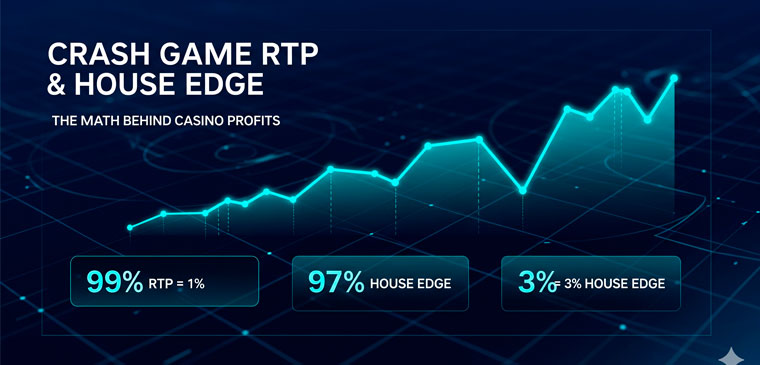
RTP and house edge describe the same long-run mathematical advantage from opposite sides. RTP estimates the share of total wagering returned to players over a very large sample, while the house edge is the expected share retained by the game before bonuses, operating costs, and other business expenses.
This page compares figures that can be traced to current provider or platform documentation. It focuses on the searches players make most often — Aviator RTP, Stake Crash RTP, BC.Game Crash house edge, JetX RTP, and the real expected cost of different settings. Where a provider does not publish a current RTP on its public page, the table says so instead of filling the gap with an unsupported number.
Quick answer: Stake currently publishes 99% RTP and a 1% house edge for Stake Crash. BC.Game documents a 1% edge in its Crash formula. Spribe lists Aviator at 97% RTP, equivalent to a 3% theoretical edge. SmartSoft publishes a wider JetX RTP range of 96.2% to 98.9%, so the exact game version matters.
RTP and House Edge: The Correct Relationship
House edge = 100% − RTP
99% RTP → 1% house edge
97% RTP → 3% house edge
For a game with 97% RTP, the theoretical gross return is $97 per $100 of total turnover and the theoretical loss is $3. That does not mean every player who wagers $100 will finish with $97. It means the average result is expected to approach that level only across a sufficiently large body of play under the stated rules.
House edge is also not a guaranteed profit on a particular round, player, hour, or day. A casino can lose money over a short sample when players hit rare high multipliers. The edge describes expected value, not a fixed fee deducted from every session.
Verified Crash Game RTP and House Edge Comparison
| Game | Published RTP | Theoretical house edge | Other confirmed data | Source note |
|---|---|---|---|---|
| Stake Crash | 99% | 1% | Up to 1,000,000×; multiplayer; Provably Fair | Stake game page |
| BC.Game Crash | 99% model | 1% | Official formula uses 99 / (1 − X) with a 1.00× minimum | BC.Game white paper |
| Aviator | 97% | 3% | Social multiplayer crash game; desktop, tablet, and mobile | Spribe game page |
| JetX | 96.2%–98.9% | 1.1%–3.8% | RNG-based; two independent bets per round | SmartSoft specifications |
| Space XY | 97% | 3% | Up to 10,000×; maximum win stated as €250,000 | BGaming game page |
| Spaceman | Not stated on the current public provider page | Not derived | Up to 5,000×; 50% cashout feature | Pragmatic Play crash portfolio |
Do not treat this as an exhaustive ranking of every crash game. It is a source-controlled comparison of major titles relevant to this page’s search traffic. The exact RTP shown inside the game at your casino should be checked before play, especially when the provider publishes a range rather than one fixed value.
What the Main Figures Mean
Stake Crash RTP: 99%
Stake currently labels Crash with a 1.00% edge and states that every round has 99% RTP. Its public game page also lists a maximum multiplier of 1,000,000×. On $1,000 of turnover, a 1% edge corresponds to an expected loss of $10 — not a promise that an individual player will lose exactly $10.
BC.Game Crash House Edge: 1%
BC.Game’s public white paper explicitly says to make the house edge 1% and applies the inverse mapping 99 / (1 − X). Results below 1.00× are set to 1.00×. Under that documented model, the theoretical RTP is 99%.
Aviator RTP and House Edge: 97% and 3%
Spribe’s current Aviator page publishes 97% RTP. The corresponding theoretical house edge is therefore 3%. The public page does not support the often-repeated claim that every casino can choose among 97%, 96%, and 94% Aviator settings, so those lower figures are not presented here as confirmed facts.
JetX RTP Is a Range, Not One Universal Number
SmartSoft currently publishes JetX RTP as 96.2% to 98.9%. That corresponds to a theoretical edge from 3.8% down to 1.1%. A review that calls JetX simply a 97% game is incomplete unless it identifies the exact build or rules screen being discussed.
Expected Loss by Total Turnover
The most useful way to compare RTP is by turnover — the total amount wagered, including money that is repeatedly recycled into later rounds.
Expected loss = total turnover × house edge
Expected gross return = total turnover × RTP
| RTP | House edge | $100 turnover | $1,000 turnover | $10,000 turnover |
|---|---|---|---|---|
| 99% | 1% | $1 | $10 | $100 |
| 98.9% | 1.1% | $1.10 | $11 | $110 |
| 97% | 3% | $3 | $30 | $300 |
| 96.2% | 3.8% | $3.80 | $38 | $380 |
| 95% | 5% | $5 | $50 | $500 |
Example: A player makes 100 bets of $2, producing $200 of turnover. At 99% RTP, the expected gross return is $198 and the expected loss is $2. At 97% RTP, the expected gross return is $194 and the expected loss is $6. The expected cost is three times higher because the edge is 3% instead of 1%.
Bet size alone is not the full cost driver. Session speed matters because more rounds create more turnover. A smaller bet played hundreds of times can cost more in expectation than a larger bet played only a few times. Use the Session Cost Calculator to compare bet size, round count, and RTP together.
How the House Edge Is Implemented
It is inaccurate to say that every crash game creates its edge through an instant-bust rate equal to the house edge. Different implementations can use different mappings:
- Reduced numerator: BC.Game’s documented model uses 99 instead of 100 in its inverse formula.
- Scaling factor: another implementation may multiply a raw result by an RTP factor.
- Minimum result or instant-bust condition: some mappings consolidate a defined part of the distribution at 1.00×.
- Rounding and maximum multipliers: flooring, truncation, and caps can slightly change the exact distribution.
The Crash Game Algorithm Guide compares the published Stake, BC.Game, and Bustabit mappings. The Crash Game Odds Guide explains when the approximation P(reach m) ≈ RTP / m is useful and where real implementations can differ.
Does the Cashout Target Change RTP?
In an ideal inverse-distribution crash model, a fixed target does not remove the house edge. Lower targets produce more frequent, smaller payouts; higher targets produce rarer, larger payouts. The expected return remains approximately the published RTP because the larger payout is offset by a lower probability of reaching it.
This should not be turned into a universal statement for every product. Partial cashout features, maximum multipliers, rounding rules, bonus mechanics, and provider-specific mappings can change the exact calculation. A strategy can change variance and session duration, but it cannot be assumed to improve expected value without a documented flaw or promotion.
Why Your Session RTP Can Be Far from the Published RTP
Theoretical RTP is not a session target. Crash games have highly skewed outcomes: many low results and a small number of very large multipliers. Missing or hitting one rare outcome can dominate a short sample.
Illustration: In an ideal 97% model with a fixed 2.00× cashout, the win probability is approximately 48.5%. Across 100 independent rounds, the expected count is 48.5 wins, but roughly 39 to 58 wins is an ordinary 95% range. With $1 bets, that range would produce a gross return from $78 to $116 on $100 of turnover — even though the theoretical RTP remains 97%.
A short losing sample therefore does not prove a lower RTP, and a short winning sample does not prove a higher one. Even 500 observed rounds are generally insufficient to certify a provider’s RTP. Use published rules, version information, audits, and reproducible verification rather than estimating the game setting from a brief session.
Can the Same Game Have Different RTP Versions?
Yes, this can happen, but it must be established for the specific provider rather than assumed. JetX is a clear current example: SmartSoft publishes a range of 96.2% to 98.9%. The exact figure for the version you are playing should appear in the in-game rules or help interface.
For Aviator, Spribe’s current public game page states 97%. Without a primary source confirming other current settings, this page does not repeat unsupported 96% or 94% claims. The same verification standard should be applied to every title.
How to Check a Crash Game’s Exact RTP
- Open the in-game rules or help panel. Record the RTP, game version, provider, and any maximum payout shown for that exact casino instance.
- Compare it with the provider’s current official page. A published range, as with JetX, means the exact build matters.
- Check the casino’s game information and terms. Look for version-specific rules rather than a generic review article.
- Do not infer RTP from recent round history. Short samples are too volatile to identify a small difference such as 97% versus 96% reliably.
- Keep evidence if the figures conflict. Save screenshots of the rules screen and ask the operator or provider which configuration is active.
RTP is only one risk factor. A high-RTP game can still produce rapid losses because of high round volume and variance. It also says nothing about withdrawal reliability, licensing, account restrictions, or whether gambling is legal where you are located.
Frequently Asked Questions
What is the typical house edge in a crash game?
There is no single universal figure. The verified examples on this page range from a 1% edge for Stake Crash and BC.Game’s documented model to 3% for Aviator and Space XY. JetX publishes a wider 1.1% to 3.8% range.
What is BC.Game Crash’s official house edge?
BC.Game’s public Provably Fair white paper explicitly sets the Crash house edge at 1%. Its documented formula uses 99 / (1 − X), which corresponds to a 99% theoretical RTP model.
What is Stake Crash RTP?
Stake’s current Crash page publishes 99% RTP and a 1% house edge. It also lists Provably Fair verification and a maximum multiplier of 1,000,000×.
What is Aviator RTP and house edge?
Spribe currently lists Aviator at 97% RTP. The corresponding theoretical house edge is 3%. Check the in-game rules for the exact version available at the casino you are using.
What is JetX RTP?
SmartSoft currently publishes a JetX RTP range of 96.2% to 98.9%, equivalent to a theoretical house edge from 3.8% down to 1.1%. A single universal 97% figure does not describe every listed version.
Does 97% RTP mean I will get $97 back from a $100 session?
No. It means the theoretical expected gross return is $97 per $100 of turnover over a very large sample. A single session can finish far below or above that amount.
How much does a 3% house edge cost?
The expected loss is 3% of turnover: $3 per $100 wagered, $30 per $1,000, or $300 per $10,000. Actual short-term results can differ substantially.
Which crash game has the highest RTP?
Among the source-verified games compared here, Stake Crash and BC.Game’s documented Crash model are both 99%. This table is not exhaustive, so it should not be interpreted as a claim that no other crash game can equal or exceed that figure.
Primary Sources and Related Guides
- Stake Crash — current RTP, house edge, maximum multiplier, and fairness labels.
- BC.Game Provably Fair white paper — 1% edge and Crash multiplier mapping.
- Spribe Aviator — current published RTP.
- SmartSoft JetX — current RTP range and game specifications.
- BGaming Space XY — RTP, maximum multiplier, and maximum win.
- Pragmatic Play Crash Games — Spaceman maximum multiplier and 50% cashout feature.
- Crash Game Odds — probabilities, losing streaks, and expected value
- Crash Game Algorithm — how published hash mappings implement the edge
- Provably Fair Explained — what cryptographic verification proves and does not prove
- Session Cost Calculator — expected loss by bet size, rounds, and RTP
- Multiplier Probability Calculator — idealized target probability at a selected RTP
- Bankroll Management — limits, turnover, and session planning
Last source review: July 23, 2026. Provider pages and game configurations can change. Recheck the in-game rules before relying on any RTP figure.