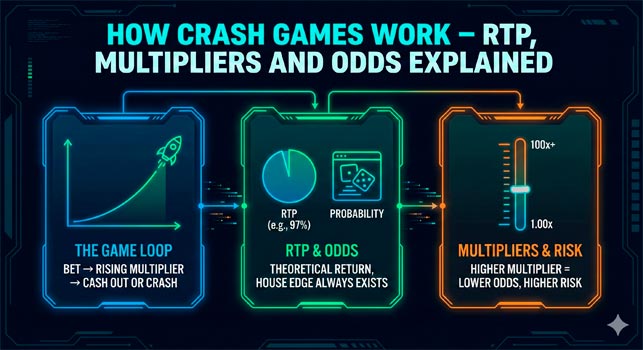
Quick answer: A crash game is a casino game built around a rising multiplier. You place a bet before the round begins and try to cash out before the multiplier stops. If you cash out at 3.00×, a $10 bet returns $30 in total: your $10 stake plus $20 profit. If the round ends before your cash out is accepted, the bet loses.
The rules are simple, but several details are commonly misunderstood. The animation does not respond to your confidence, bet size, or previous results. Manual cash out does not let you influence the crash point. A low target can produce more frequent wins, but it does not remove the house edge.
This beginner's guide explains the playing sequence, payouts, auto cashout, odds, RTP, fairness systems, and the difference between the visual multiplier and the underlying result. Provider-specific cryptography and formulas are covered in separate technical guides.
What Is a Crash Game?
Crash gambling is a wager on how long a multiplier will continue before a round ends. Most classic versions show a plane, rocket, line, character, or simple number moving upward from 1.00×. The player does not choose the final multiplier. The player's decision is whether to secure the current value or continue risking the bet for a potentially larger return.
Many crash games are multiplayer: everyone watching the same round sees the same rising multiplier and crash point. Other products use a single-player or step-based variation. The presentation can differ substantially, so the rules and game-information panel should be checked before betting.
The key distinction: the crash point determines how far the round goes; your cashout point determines whether your individual bet wins. Clicking earlier or later changes your payout, not the underlying round result.
How to Play a Crash Game: One Round in Five Steps
Enter the amount you want to risk. Some games also let you prepare more than one separately controlled bet, use autoplay, or set stop-on-profit and stop-on-loss controls.
For example, choosing 2.00× instructs the game to cash out automatically if the round reaches that target under the provider's rules.
When the round begins, the multiplier starts at or near 1.00× and rises according to the game's display animation.
A manual cashout request secures the displayed value only if the game accepts it before the round ends. An auto-cashout request is evaluated according to the target selected before the round.
Players who already cashed out receive their returns. Bets that were still active lose. A new betting window then opens for the next round.
How Crash Game Payouts Work
The total return is the stake multiplied by the accepted cashout multiplier:
Net profit = bet × (cashout multiplier − 1)
| Bet | Cashout multiplier | Total return | Net profit |
|---|---|---|---|
| $10 | 1.20× | $12 | $2 |
| $10 | 1.50× | $15 | $5 |
| $10 | 2.00× | $20 | $10 |
| $10 | 5.00× | $50 | $40 |
The multiplier is not pure profit. A 2.00× cashout doubles the total amount returned, but only one half of that return is profit because the original stake is included.
Why Several Winning Rounds Can Still Leave a Loss
With a $10 stake and a 1.20× cashout, a winning bet earns $2 net. Four wins followed by one loss give 4 × $2 − $10 = −$2. That is an 80% win rate and a losing result. Five such wins offset one lost $10 stake; they do not create a guaranteed recovery sequence.
Use the settled bet history to distinguish the stake, total return and net result. A rising number on the screen is not a settled payout. If cashout and crash appear at the same displayed multiplier, the provider's timing and settlement rules decide the result.
Manual Cash Out vs Auto Cashout
Manual cash out
You click while the multiplier is rising. This gives you control over the decision during the round, but the request still has to reach and be accepted by the game before the crash.
Main risk: hesitation, reaction time, device performance, or network delay can cause a request to arrive too late.
Auto cashout
You select a target before the round. If the multiplier reaches the target under the game's rules, the system attempts or executes the cashout automatically.
Main benefit: it reduces manual reaction and timing risk. It does not improve the probability distribution or overcome the house edge.
Auto cashout is not a prediction tool. It is only an instruction. A target of 2.00× loses whenever the round ends before reaching 2.00×, regardless of whether the instruction was automatic or manual.
What Makes the Multiplier Stop?
The displayed multiplier stops when the game reaches its internally generated result. The exact generation method depends on the product. A crash game may use a committed hash chain, server and client seeds, a certified random number generator, or another provider-specific process.
It is therefore inaccurate to say that every crash point is generated in the same way or always exists before every player places a bet. Stake's published Crash model uses a committed hash-chain system. Spribe describes combining a server seed with player-generated client seeds and hashing the combined input with SHA-512. Other regulated products may use certified RNG rather than player-verifiable seed data.
The visual curve is also not a universal probability formula. Some games make the multiplier appear to accelerate; others use a different animation or step-based mechanic. The animation communicates the current payout value. It does not mean that clicking at a particular visual moment influences the hidden result.
Beginner version: the game determines when the round ends; you determine only when to leave the round. For provider-specific hash chains, bit widths, HMAC inputs, and formulas, use the Crash Game Algorithm Guide.
Crash Game Odds in Plain English
Higher multipliers must be less likely than lower multipliers. Otherwise, a game could not regularly pay larger amounts and retain a house edge. In a common idealized inverse model with RTP represented by r, the approximate probability of reaching at least target m is:
For illustration, the following table uses a 97% RTP model. It is not a promise about every provider. Exact results can differ because of maximum multipliers, flooring, rounding, instant-crash rules, and other implementation details.
| Target | Illustrative probability of reaching target | Net profit on a winning $10 bet |
|---|---|---|
| 1.50× | About 64.67% | $5 |
| 2.00× | About 48.50% | $10 |
| 5.00× | About 19.40% | $40 |
| 10.00× | About 9.70% | $90 |
Lower targets create more frequent small returns. Higher targets create rarer and larger returns. Neither pattern turns a negative-expectation game into a positive-expectation game.
Does the Cashout Target Change the House Edge?
In the idealized model above, the expected return at any valid target is approximately the same because the probability falls as the payout rises. At 2.00×, for example, 0.485 × 2.00 = 0.97. At 10.00×, 0.097 × 10.00 = 0.97.
Real games can deviate slightly because of caps, rounding, minimum results, bonus mechanics, or alternative distributions. The correct RTP and house edge should come from the current game rules, not from a generic crash calculator.
For detailed probability tables, see Crash Game Odds. For provider RTP values and expected-cost examples, see Crash Game RTP and House Edge.
Do Crash Games Have Patterns?
Round histories contain streaks because random-looking sequences naturally produce clusters. Several low results can appear in a row, followed by a high multiplier, or another low result. The presence of a streak does not show that the next round is due to compensate for it.
In a correctly implemented system, previous displayed multipliers do not reveal the next hidden seed or random input. A sequence such as 1.10×, 1.32×, 1.05×, and 1.80× does not make a 10.00× result more likely on the following round. This mistaken expectation is the gambler's fallacy.
Pattern charts describe the past; they do not expose the next result. A predictor app needs hidden future inputs or a real implementation vulnerability. It cannot derive them from the visible multiplier history alone.
For the security distinction between verification and prediction, read Can You Predict Crash Games?.
Provably Fair vs Certified RNG
Both terms concern result integrity, but the trust models differ.
| System | What the player can check | What still requires trust |
|---|---|---|
| Provably Fair | Depending on the implementation, a player can verify seed commitments, hash-chain continuity, or reproduction of a completed result. | Correct implementation, published parameters, account security, withdrawals, licensing, and operator conduct. |
| Certified RNG | The player usually sees the game rules and published RTP but cannot independently reproduce each individual round. | The provider, operator, regulator, and testing laboratory responsible for certification and deployment. |
Provably Fair does not automatically prove that a casino is safe or that the RTP is favorable. Certified RNG does not mean a result is predictable or manipulated. These systems answer narrower questions about how outcomes are generated and checked.
For the exact limits of cryptographic verification, see Provably Fair in Crash Games.
Common Crash Game Features
Auto cashout
Sets a target before the round and reduces the need for a perfectly timed manual click.
Autoplay
Repeats bets under configured limits. It increases turnover quickly and does not improve expected return.
Multiple bet panels
Some games allow two or more separately controlled bets with different targets in the same round.
Partial cashout
Some variants let the player secure part of the position while leaving the remainder active.
Live bets and chat
Multiplayer versions may display other players' bets, cashouts, leaderboards, and chat activity.
Round history
Shows previous multipliers for transparency and reference, but does not provide a prediction signal.
For example, Stake's official Crash description includes manual and automatic betting controls, multiplayer rounds, a 99% RTP, and a 1% house edge. Spribe lists Aviator as a 97% RTP social multiplayer game. Pragmatic Play describes Spaceman as a crash game with a 50% partial-cashout feature. These examples show why features and parameters should be checked game by game rather than assumed from the genre.
Separate bet panels let you choose different stakes and cashout targets. In a shared-round game they do not create two independent crash points. An early crash can lose both bets, and a round reaching the higher target must first pass the lower one.
For an illustration, consider two $5 bets with targets of 2× and 10×. If neither cashout succeeds, the total loss is $10. If only the 2× cashout succeeds, its $10 gross return offsets the combined $10 stake: the round breaks even. If both succeed, the gross return is $10 + $50 = $60, for $50 net profit. These examples assume successful target settlement and no fees or bonuses.
Splitting a stake changes the payout pattern, but the two bets remain exposed to the same round. Partial cashout is a different feature: it settles part of one position while the remainder stays active. Check which controls the actual game offers.
Beginner Mistakes to Avoid
Confusing Frequent Wins With Profitability
A 1.20× target can win often, but each win earns only 0.20 units of profit per unit staked. One loss removes the profit from several small wins. Win rate and expected return are not the same metric.
Increasing Stakes Because a High Multiplier Feels Due
Past low results do not create a debt that the game must repay. Increasing a bet after a losing streak increases exposure without changing the next-round probability.
Using Autoplay Without a Turnover Limit
Fast rounds can generate a large amount of wagering in a short period. A small house edge applied repeatedly can still produce substantial expected losses. Session duration, number of bets, and maximum loss should be decided before autoplay starts.
Assuming Every Game Has the Same RTP
RTP, maximum multiplier, bet limits, rounding, and bonus features vary by game and sometimes by approved configuration. Check the information panel in the exact version being played.
Trusting Predictor Apps or Signal Groups
A legitimate verifier checks completed rounds. A predictor claims to know a hidden future result. Those are different functions. Requests for activation fees, account credentials, APK installation, or remote access are strong warning signs.
A Simple Beginner Checklist
- Read the game rules and confirm the displayed RTP.
- Check whether the game uses Provably Fair verification or certified RNG.
- Understand whether the displayed return includes the original stake.
- Use a fixed stake that does not need to be recovered after a loss.
- Set auto cashout only for consistency, not because it changes the odds.
- Set a session limit before enabling autoplay.
- Treat every bet as capable of losing immediately.
Crash games are negative-expectation gambling products. No cashout target, staking progression, pattern chart, or autoplay configuration removes the house edge. Do not use money needed for bills, debt payments, or essential expenses.
Frequently Asked Questions
How do crash gambling games work?
You place a bet before a round, watch a multiplier rise, and try to cash out before the round ends. A successful cashout returns the bet multiplied by the accepted cashout value. An active bet loses if the crash happens first.
Are crash games rigged?
A broad yes-or-no answer is not possible for every site and game. Provably Fair systems can let players verify specified parts of completed rounds, while regulated RNG games rely on provider and laboratory testing. Neither system guarantees that an operator is financially safe or handles withdrawals properly.
Can crash game patterns predict the next multiplier?
No reliable prediction can be made from the visible round history in a properly implemented game. Streaks and clusters occur naturally, but they do not reveal an unreleased seed, hash preimage, or future RNG value.
What is the best multiplier to cash out at?
There is no universal best target. Lower targets generally win more often and pay less; higher targets win less often and pay more. In common inverse-distribution models, valid targets are designed to retain roughly the same house edge, although caps and rounding can create small differences.
Is auto cashout better than manual cash out?
Auto cashout is more consistent because the target is selected before the round and it reduces reaction-time risk. It does not increase the probability of reaching that target or improve the theoretical RTP.
Can a crash game end at 1.00×?
Yes. Some implementations allow an immediate or near-immediate crash, leaving no practical opportunity for a manual cashout. The exact minimum-result treatment depends on the game's rules and formula.
How long does a crash game round last?
There is no universal duration. A low crash point can end almost immediately, while a high multiplier takes longer to display. Animation speed and betting-window length also vary between products.
What is the maximum multiplier?
It varies by game. Some products publish a fixed maximum; others advertise very high caps. Always use the current game-information panel because a limit from one crash game should not be applied to another.
Can I play a crash game for free?
Some providers or casino sites offer demo mode, but availability can depend on the operator, device, and jurisdiction. Demo play can explain the interface, but it does not change the mathematical behavior of real-money play.
Deep-Dive Guides
Crash Game Algorithm
Verified Stake, BC.Game, and Bustabit formulas, plus the public limits of Aviator documentation.
Provably Fair Explained
Commitments, server seeds, client seeds, hash chains, and what verification can actually prove.
Crash Game Odds
Target probabilities, variance, streaks, and the assumptions behind the inverse model.
RTP and House Edge
Provider-specific RTP values, expected loss, turnover, and session-cost examples.
Crash Game Strategy
Bankroll controls, target selection, and why staking systems do not beat expected value.
Probability Calculator
Explore idealized target probability at different RTP settings.
Primary Sources and Notes
- Stake Crash — official description of betting flow, manual and automatic controls, multiplayer format, RTP, and house edge.
- Stake Provably Fair: Game Events — official note that Stake Crash uses a separate salt-hash-based model.
- Spribe Aviator — official description of the rising-multiplier mechanic, multiplayer features, and published RTP.
- Spribe Provably Fair — official description of server seeds, player seeds, SHA-512, and round verification.
- Pragmatic Play Crash Games — official overview of auto cashout, autoplay, and Spaceman's partial-cashout feature.
Last reviewed: September 26, 2026. Providers can change rules, RTP configurations, interfaces, maximum multipliers, and verification methods. Confirm the current information inside the exact game version before relying on a figure or feature described here.