
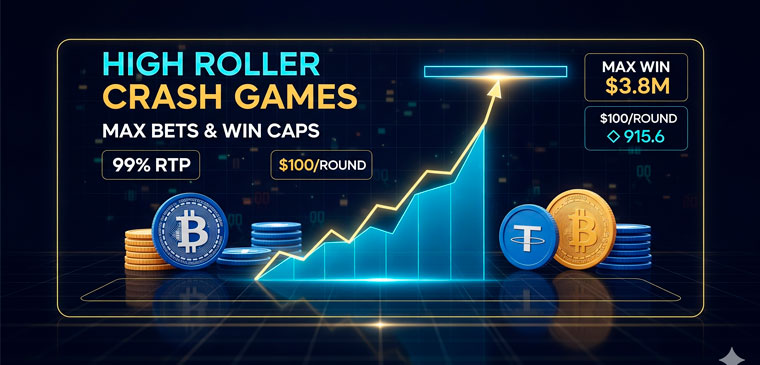
Most crash game guides assume everyone bets $1 per round. If you’re playing $50-$100+ per round, the math changes — not in how the algorithm works, but in how much each session costs, which max win caps actually matter, and which games are worth your bankroll.
Crash games have some of the lowest house edges in online gambling (1-3%), which means high-volume players lose less per dollar wagered than in almost any other format. But bet limits, max win caps, and RTP differences that are trivial at $1 bets become significant at $100+ bets. This guide covers what high rollers specifically need to know.
Max Bet and Max Win: Full Comparison
The single most important table for high-stakes crash players — because a max win cap you hit is money you can’t earn:
| Game | RTP | Max Bet | Max Multiplier | Max Win (Cash) | Provably Fair |
|---|---|---|---|---|---|
| Stake Crash | 99% | ~100 BTC | 1,000,000× | ~5 BTC / currency equiv. | ✅ |
| BC.Game Crash | 99% | High (crypto-based) | 1,000,000× | Up to ~$3.8M (crypto) | ✅ |
| BetFury Crash | 99.02% | Varies by VIP tier | 80,000× | Up to $300K (VIP 3) | ✅ |
| Spaceman | 96.5% | $100 | 5,000× | $500,000 | ❌ (Certified RNG) |
| Bodog ThunderCrash | ~96-97% | Varies | Uncapped | $100,000 | ❌ |
| Aviator | 97% | $100 (×2 bets) | 100× | $10,000 | ✅ |
| JetX | 97% | $100 (×3 bets) | 25,000× | $10,000 | ✅ |
| Space XY | 97% | $100 | 10,000× | Varies by casino | ❌ (Certified RNG) |
The Cost of High-Stakes Sessions
At small bets, the difference between 97% and 99% RTP feels academic. At high stakes, it’s concrete money:
| Session (100 rounds) | 97% RTP Cost | 99% RTP Cost | You Save at 99% |
|---|---|---|---|
| $10/round ($1,000 wagered) | $30 | $10 | $20 |
| $50/round ($5,000 wagered) | $150 | $50 | $100 |
| $100/round ($10,000 wagered) | $300 | $100 | $200 |
| $500/round ($50,000 wagered) | $1,500 | $500 | $1,000 |
$100/round × 100 rounds × 3% = $300 (at 97% RTP)
$100/round × 100 rounds × 1% = $100 (at 99% RTP)
At $100/round, choosing 99% RTP over 97% saves $200 per session. Over 10 sessions, that’s $2,000. Over a month of daily play, $6,000. RTP selection is the single highest-impact decision a high roller can make — more impactful than any betting strategy.
Which Game for Which Bankroll?
| If Your Bankroll Is… | Best Game | Why |
|---|---|---|
| $500-$2,000 | BC.Game / BetFury Crash (99% RTP) | Lowest house edge, flexible bet sizes, adequate max win. At $10-20/round, the $10K caps of Aviator/JetX are unlikely to limit you. |
| $2,000-$10,000 | BC.Game / Stake Crash (99% RTP) | High bet limits, high max win, Provably Fair. RTP savings of $200/session vs 97% games compound quickly at this volume. |
| $10,000+ | Stake Crash or BC.Game Crash | Only games with bet limits and max wins high enough to accommodate serious volume. 99% RTP + Provably Fair + crypto-native infrastructure. |
| $500-$2,000 (want regulated) | Spaceman | Regulated-market availability (UKGC, MGA), $500K max win, 50% partial cashout. Tradeoff: 96.5% RTP costs $350 per $10,000 wagered. |
High-Stakes Strategy Differences
The core math doesn’t change at high stakes — the algorithm doesn’t know your bet size. But three practical factors shift:
1. Max Win Caps Become Binding
At $1/bet on Aviator, the 100× max multiplier means a $100 max win — generous relative to the bet. At $100/bet, the $10,000 max win means you’re effectively capped at 100×, identical to the theoretical max. You can never exceed $10,000 regardless of what the multiplier reaches. High rollers need games where the max win cap is high enough that it doesn’t reduce the effective multiplier range.
2. Martingale Ceiling Hits Faster
The Martingale strategy doubles bets after losses. Starting at $100, the progression is $100 → $200 → $400 → $800 → $1,600 → $3,200 → $6,400 → $12,800. That’s $25,500 invested to recover $100 of profit by round 8. On provider games with $100 max bet, Martingale is impossible — you hit the cap on round 1. Only crypto casino-originals with high bet limits can sustain progressive strategies at high stakes.
3. RTP Savings Compound Faster
A recreational player at $1/round barely notices the difference between 97% and 99% RTP — it’s $2 per 100 rounds. A high roller at $100/round loses $200 more per session on a 97% game than a 99% game. Over 50 sessions, that’s $10,000 in unnecessary cost. At high stakes, game selection based on RTP is not optimization — it’s financial hygiene.
What High Rollers Should Avoid
Aviator at max bet. $100 max bet × 100× max multiplier = $10,000 ceiling. For a $5,000+ bankroll, this cap is restrictive. Aviator is excellent for casual play, but its limits weren’t designed for high-stakes volume.
JetX at max bet. Same $10,000 cap despite a theoretical 25,000× multiplier. The cap makes the advertised max multiplier meaningless for anyone betting more than $0.40 per round. JetX’s value is its 3-bet system, not its high-roller capacity.
Any 95% RTP game at volume. Big Bass Crash (95.5% RTP) costs $450 per $10,000 wagered vs $100 for a 99% RTP game. At high stakes, that $350 difference per session is unjustifiable unless the bonus mechanic specifically appeals to you.
“VIP crash predictor” services. No tool predicts crash outcomes at any bet size. The cryptographic hash that determines each crash point is indifferent to your wager. High rollers are targeted by premium scam services because the potential payoff for the scammer is higher — the scam itself is identical to the $10 versions.
Deposit and Withdrawal Considerations
High-stakes crash play almost always involves cryptocurrency. Practical considerations:
BTC volatility during sessions. A 2-hour session at high stakes can coincide with a 2-3% BTC price move. On a $10,000 crypto bankroll, that’s $200-300 of value change unrelated to gameplay. For session cost predictability, USDT eliminates this variable. See our BTC crash guide for the full volatility analysis.
Withdrawal limits. Some platforms cap daily/weekly withdrawals. Stake caps at ~5 BTC or currency equivalent per transaction. BC.Game limits vary by VIP tier. Always verify withdrawal limits before depositing a large bankroll — a platform that accepts a $50,000 deposit but limits withdrawals to $5,000/week creates a 10-week cash-out timeline.
Network fees at scale. At high deposit amounts, on-chain BTC fees ($1-20) become negligible. The percentage-based cost advantage of crypto over credit cards (3-5% cash advance fees) becomes substantial: 3% of a $10,000 deposit is $300 in saved fees. See our payment methods comparison.
Frequently Asked Questions
What crash game has the highest max bet?
Stake Crash allows bets up to approximately 100 BTC per round. BC.Game Crash also supports very high crypto limits. Provider games (Aviator, JetX, Spaceman) cap at $100-$300 per round. Casino-original crash games on crypto platforms consistently offer higher limits than third-party provider games.
What crash game has the highest max win?
BC.Game Crash has reported payouts up to ~$3.8M in crypto. Stake Crash offers 1,000,000× max multiplier with win capped at ~5 BTC. Among provider games, Spaceman leads at $500,000 (5,000× on $100 bet). Aviator and JetX are both capped at $10,000 — poor choices for high-roller payouts.
How much does a high-roller crash session cost?
At $100/round over 100 rounds: $300 expected loss at 97% RTP, $100 at 99% RTP. The $200 difference per session is the primary reason high rollers should prioritize 99% RTP casino-originals. See our RTP comparison for the full breakdown.
Is crash gambling good for high rollers?
The house edge (1-3%) is among the lowest in online gambling, which benefits high-volume players more than casual ones. But max win caps on some games ($10K for Aviator/JetX) limit upside. The best high-roller setup: 99% RTP casino-original with Provably Fair verification and high withdrawal limits.
Do crash games have VIP programs?
Provider games (Aviator, JetX, Spaceman) don’t have built-in VIP systems — VIP perks come from the hosting casino. Crypto casino-originals (BC.Game, Stake, BetFury) offer tiered VIP programs with increased limits, rakeback, cashback, and dedicated account managers for high-volume players.