

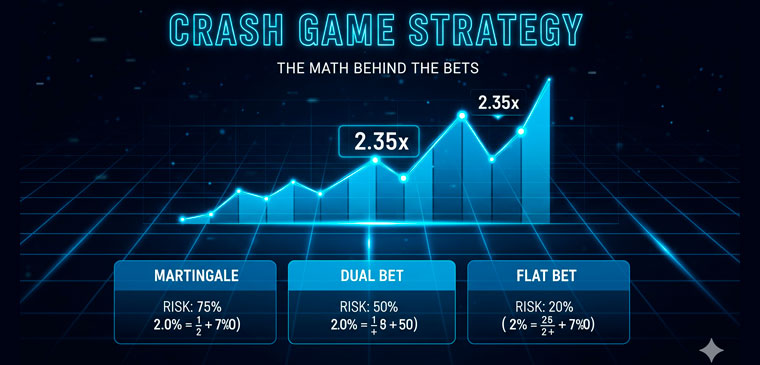
Search “crash game strategy” and you’ll find the same advice repeated everywhere: use auto-cashout, try the Martingale system, set a stop-loss. None of it tells you the one thing that actually matters: how much does each strategy cost you per session, and how likely is it to blow up your bankroll?
This guide runs the math on five common approaches. We’ll show the expected cost per 100 rounds, the probability of busting your bankroll, and which crash games are best suited to each strategy. No vague “tips” — just arithmetic.
The One Rule No Strategy Can Break
97% RTP game: $1 bet × 3% = $0.03 expected loss per round
99% RTP game: $1 bet × 1% = $0.01 expected loss per round
No strategy changes these numbers.
Every crash game takes a fixed percentage of your bets over time. At 97% RTP (Aviator, JetX, Space XY), you pay $3 per $100 wagered. At 99% RTP (BC.Game Crash, Stake Crash), you pay $1 per $100. At 96.5% RTP (Spaceman), you pay $3.50. Strategy changes the distribution of wins and losses within a session — not the total cost across many sessions.
→ For RTP differences between games, see our full RTP comparison.
Strategy 1: Flat Bet (Fixed Amount, Fixed Target)
Bet the same amount every round. Cash out at the same multiplier every round. This is the baseline — the simplest approach and the one all other strategies are measured against.
Flat Bet at 2x Target: 100-Round Session ($1/bet, 97% RTP)
| Metric | Value |
|---|---|
| Win probability per round | 48.5% |
| Expected wins in 100 rounds | ~48-49 |
| Expected losses in 100 rounds | ~51-52 |
| Total wagered | $100 |
| Expected return | $97 |
| Expected cost (loss) | -$3.00 |
| Bust probability (starting $50 bankroll) | ~8% |
| Best-case realistic session (top 10%) | +$10 to +$20 |
| Worst-case realistic session (bottom 10%) | -$15 to -$25 |
Strategy 2: Martingale (Double After Loss)
Double your bet after every loss. When you win, reset to base bet. Target: 2x cashout. The theory: one win recovers all previous losses plus one unit of profit.
Martingale Escalation Table ($1 base, 2x target)
| Consecutive Losses | Current Bet | Total Invested | Profit If You Win | Probability of This Streak |
|---|---|---|---|---|
| 0 (first bet) | $1 | $1 | $1 | — |
| 1 | $2 | $3 | $1 | 51.5% |
| 2 | $4 | $7 | $1 | 26.5% |
| 3 | $8 | $15 | $1 | 13.7% |
| 4 | $16 | $31 | $1 | 7.0% |
| 5 | $32 | $63 | $1 | 3.6% |
| 6 | $64 | $127 | $1 | 1.9% |
| 7 | $128 | $255 | $1 | 0.96% |
Why it doesn’t beat the house: Martingale redistributes your losses into rare, large events. Instead of losing $3 steadily per 100 rounds (flat bet), you win $1 most sessions and occasionally lose $127+. The average across many sessions is still -$3 per $100 wagered. You’re paying the same house edge — just with a different emotional experience.
Bankroll requirement: To survive 7 losses in a row, you need $255+ bankroll for a $1 base bet. To survive 10 losses, $1,023. Most players don’t have this, which means Martingale hits their bankroll limit before the recovery bet can be placed.
Game-specific note: Martingale is worse in Spaceman ($1 min bet) because you can’t start at $0.10 — your escalation reaches $128 by loss 7. In Aviator ($0.10 min), you can start smaller: $0.10 → $0.20 → $0.40 → $0.80 → $1.60 → $3.20 → $6.40 → $12.80. Still dangerous, but less capital-intensive.
Strategy 3: Anti-Martingale (Double After Win)
Double your bet after every win. When you lose, reset to base bet. Target: 2x cashout. The theory: exploit “hot streaks” by increasing exposure during wins.
Anti-Martingale Example ($1 base, 2x target, 3-win cap)
| Round | Bet | Result | Net P&L | Action |
|---|---|---|---|---|
| 1 | $1 | Win (+$1) | +$1 | Double next bet |
| 2 | $2 | Win (+$2) | +$3 | Double next bet |
| 3 | $4 | Win (+$4) | +$7 | 3-win cap reached → reset |
| 4 | $1 | Loss (-$1) | +$6 | Stay at base |
| 5 | $1 | Loss (-$1) | +$5 | Stay at base |
The key rule: Set a win cap (2-3 consecutive wins) and reset. Without a cap, one loss after a long win streak erases all accumulated profit. The 3-win cap means your maximum exposed bet is $4, and you lock in $7 profit from a 3-win streak.
Best for: Players who enjoy streaky sessions and can emotionally handle many small losses punctuated by occasional big wins. Lower bust risk than Martingale.
Strategy 4: Dual Bet Split (Two Targets, One Round)
Place two bets per round at different targets. One bet provides frequent small wins (safety), the other provides rare large wins (growth). Available in Aviator (2 bets), JetX (2-3 bets), and Space XY (2 bets).
Dual Bet: $10 Total Per Round ($7 at 1.5x + $3 at 5x)
| Metric | Safety Bet ($7 @ 1.5x) | Growth Bet ($3 @ 5x) | Combined |
|---|---|---|---|
| Win rate | 64.7% | 19.4% | — |
| Profit per win | +$3.50 | +$12.00 | — |
| Wins per 100 rounds | ~65 | ~19 | — |
| Revenue per 100 rounds | $227.50 | $228.00 | $455.50 |
| Total wagered per 100 rounds | $700 | $300 | $1,000 |
| Expected return | $679 | $291 | $970 |
| Expected cost | -$21 | -$9 | -$30 |
The dual bet costs exactly the same as flat betting $10 per round at any single target: -$30 per 1,000 wagered (3% house edge). What changes is the session profile: the safety bet wins frequently enough to offset losing rounds, while the growth bet provides occasional +$12 spikes. The psychological effect is significant — you feel like you’re winning even during “losing” stretches because the safety bet is paying out.
Which games support this: JetX (2-3 bets), Aviator (2 bets), Space XY (2 bets). Spaceman only allows 1 bet but has a 50% partial cashout that creates a similar effect.
→ For JetX’s 3-bet version, see our JetX review.
Strategy 5: Session Target (Stop-Win + Stop-Loss)
Set a profit target and a loss limit before you start. Stop playing when either is hit. This doesn’t change the math — but it prevents the #1 bankroll killer: continuing to play after a winning session until the gains are gone.
Session Target Example: $50 Bankroll, $1 Flat Bet at 2x
| Parameter | Setting | Reasoning |
|---|---|---|
| Stop-win | +$15 (30% of bankroll) | Lock in a winning session before variance reverses it |
| Stop-loss | -$20 (40% of bankroll) | Preserve $30 for a future session |
| Max rounds | 100 | Prevent fatigue-driven mistakes |
| Expected outcome | -$3 (3% of $100 wagered) | The house edge applies regardless of session rules |
Why session targets work psychologically: Without them, winning players keep playing until they give back their gains, and losing players keep playing hoping to recover. Session targets force a stop at a predetermined point. You won’t beat the house edge — but you’ll have more winning sessions and avoid catastrophic losing sessions.
→ For stop-loss and bet sizing by bankroll, see our bankroll management cheat sheet.
Strategy Comparison: Which Should You Use?
| Strategy | Cost / 100 Rounds ($1 base, 97% RTP) | Bust Risk ($50 bankroll) | Session Feel | Best Game |
|---|---|---|---|---|
| Flat Bet (2x) | -$3 | ~8% | Steady, predictable | Any (best: 99% RTP games) |
| Martingale (2x) | -$3* | ~25-35% | Many small wins, rare huge losses | Aviator ($0.10 start) |
| Anti-Martingale (2x, 3-cap) | -$3* | ~12% | Many small losses, rare big wins | Any |
| Dual Bet (1.5x + 5x) | -$3 | ~6% | Frequent small wins + spikes | JetX, Aviator |
| Session Target | -$3 | Controlled | Bounded, disciplined | Any |
*Martingale and Anti-Martingale average -$3/100 rounds over many sessions. Individual sessions vary wildly. Martingale bust risk is higher because a single losing streak can exceed bankroll limits.
What Actually Reduces Your Cost
Since no strategy changes the house edge, the only real “strategies” are:
1. Choose the highest RTP game available. BC.Game Crash (99% RTP) costs $1/100 rounds. Aviator (97%) costs $3. Spaceman (96.5%) costs $3.50. Over 1,000 rounds at $1/bet, that’s a $25 difference between Spaceman and BC.Game. See our RTP comparison.
2. Verify the game is Provably Fair. RNG-only games (Spaceman, Space XY) could theoretically run at lower-than-stated RTP. Provably Fair games (Aviator, JetX) let you verify every round. See our Provably Fair guide.
3. Use bankroll management to maximize session length. More rounds = more entertainment value per dollar. A $50 bankroll at $0.25/bet gives you 200 rounds of play vs 50 rounds at $1/bet. See our bankroll guide.
4. Set session limits. Stop-win and stop-loss targets don’t change expected value but prevent emotional decisions that accelerate losses.
5. Never chase losses. Switching to Martingale or higher targets after a losing streak feels logical but doesn’t change the math. Each round is independent. See our high vs low risk guide.
Predictors, Signals, and Bots: Why They’re All Scams
→ For how the cryptographic system works, see our Provably Fair verification guide.
Frequently Asked Questions
What is the best crash game strategy?
No strategy changes the house edge. The cheapest approach is flat betting on a 99% RTP game ($1 cost per $100 wagered). On 97% RTP games, all strategies cost $3 per $100. Choose your strategy based on session preference — steady (flat bet), streaky (anti-Martingale), or disciplined (session targets). See our volatility guide for choosing between low and high targets.
Does Martingale work in crash games?
It wins most sessions but risks catastrophic loss. After 7 consecutive losses at 2x target, you’ve invested $255 to recover $1. This happens roughly once every 90 sessions — and one such event erases all previous small wins. Long-term expected cost: identical to flat betting.
Can you predict crash game results?
No. Provably Fair games use cryptographic hashing. Each round is independent. “Predictor” apps and Telegram bots are scams. Past round history provides zero information about future results.
What cashout target has the best odds?
All targets have the same expected return (RTP). 1.5x wins 64.7% for $0.50 profit. 10x wins 9.7% for $9 profit. Both return $0.97 per $1 bet at 97% RTP. For the formula, see our algorithm guide.
How much does crash game strategy cost per session?
97% RTP: $3 per $100 wagered. 99% RTP: $1 per $100. 96.5% RTP: $3.50 per $100. Strategy choice doesn’t change these numbers. See RTP explained.
Which crash game is best for strategy?
Lowest cost: 99% RTP casino-originals. Best multi-bet: JetX (3 bets). Best partial cashout: Spaceman. Best autoplay: Space XY (1,000 rounds). Best trust: Aviator (Provably Fair + community). Full comparison in our provider guide.
What is the 1-3-2-6 betting strategy in crash games?
The 1-3-2-6 system is a positive progression: bet 1 unit, then 3, then 2, then 6 on consecutive wins. Reset to 1 after any loss or after completing the full sequence. At a 2x cashout target on 97% RTP, the probability of completing all four steps (4 consecutive wins) is roughly 5.5%. The strategy doesn’t change the house edge — it reshapes variance. Most sessions produce small losses; the occasional full sequence produces a larger win. Expected cost: still $3 per $100 wagered, identical to flat betting and every other strategy on this page.
Does the Fibonacci strategy work in crash games?
The Fibonacci sequence (1, 1, 2, 3, 5, 8, 13…) increases your bet one step after a loss and decreases two steps after a win. It escalates slower than Martingale — after 7 consecutive losses, your bet is $13 vs Martingale’s $128. The tradeoff: recovery requires multiple consecutive wins rather than one, spreading risk across more rounds. Like all progression systems, it does not change the expected cost ($3 per $100 at 97% RTP). It’s a gentler ride to the same mathematical destination.
Can you win crash games consistently?
No strategy produces consistent long-term profits. The house edge guarantees the casino wins over hundreds of sessions. What you can control: choose 99% RTP over 97% (saves $2 per $100 wagered), set session limits through bankroll management, verify games are Provably Fair, and recognize that short winning streaks are normal variance — not evidence of a working system.
Is the Martingale strategy 100% profitable?
No. Martingale wins roughly 89 out of 90 sessions at a 2x target — but the 1 losing session erases all previous gains. After 7 consecutive losses ($1 → $2 → $4 → $8 → $16 → $32 → $64 → $128), you’ve invested $255 to recover $1 of profit. Table limits and bankroll limits make continued doubling impossible. Long-term expected return is identical to flat betting: -3% of total wagered on a 97% RTP game.