

Every crash game multiplier has an exact mathematical probability attached to it. This isn’t hidden or complicated — it follows directly from the algorithm that generates crash points. If you know the RTP of the game you’re playing, you can calculate the exact probability of reaching any multiplier, the expected value of every bet, and the real cost per hour of your play.
This guide gives you the full probability breakdown: tables for every major multiplier from 1.01x to 1,000x, expected value formulas, a comparison with other casino games, and the mathematical proof that no strategy can overcome the house edge. Use this alongside our Multiplier Probability Calculator to check odds for any specific target.
The Core Formula: How Crash Game Probabilities Work
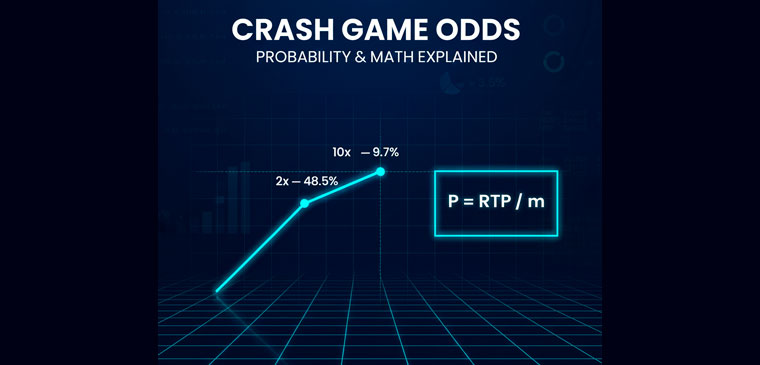
In a crash game with RTP = r, the probability of the multiplier reaching at least m before crashing is:
Where r is the RTP as a decimal (0.97 for 97%, 0.99 for 99%) and m is the target multiplier. This is the survival function of the crash point distribution — it tells you the probability that the game survives to at least multiplier m.
A few examples to build intuition:
In a 97% RTP game (like Aviator at default settings): the probability of reaching 2x is 0.97 / 2 = 48.5%. The probability of reaching 10x is 0.97 / 10 = 9.7%. The probability of reaching 100x is 0.97 / 100 = 0.97%.
In a 99% RTP game (like Bustabit or Stake Crash): the probability of reaching 2x is 0.99 / 2 = 49.5%. The probability of reaching 10x is 0.99 / 10 = 9.9%. The probability of reaching 100x is 0.99 / 100 = 0.99%.
The difference seems small per round, but it compounds over hundreds of bets. That’s what the RTP comparison is really about.
Complete Probability Table: Odds for Every Major Multiplier
| Target Multiplier | 95% RTP | 96% RTP | 97% RTP | 99% RTP | Win Frequency (97%) |
|---|---|---|---|---|---|
| 1.01x | 94.1% | 95.0% | 96.0% | 98.0% | ~96 of 100 rounds |
| 1.10x | 86.4% | 87.3% | 88.2% | 90.0% | ~88 of 100 rounds |
| 1.50x | 63.3% | 64.0% | 64.7% | 66.0% | ~65 of 100 rounds |
| 2.00x | 47.5% | 48.0% | 48.5% | 49.5% | ~49 of 100 rounds |
| 3.00x | 31.7% | 32.0% | 32.3% | 33.0% | ~32 of 100 rounds |
| 5.00x | 19.0% | 19.2% | 19.4% | 19.8% | ~19 of 100 rounds |
| 10.00x | 9.5% | 9.6% | 9.7% | 9.9% | ~10 of 100 rounds |
| 20.00x | 4.75% | 4.80% | 4.85% | 4.95% | ~5 of 100 rounds |
| 50.00x | 1.90% | 1.92% | 1.94% | 1.98% | ~2 of 100 rounds |
| 100.00x | 0.95% | 0.96% | 0.97% | 0.99% | ~1 of 100 rounds |
| 500.00x | 0.19% | 0.19% | 0.19% | 0.20% | ~1 of 500 rounds |
| 1,000x | 0.095% | 0.096% | 0.097% | 0.099% | ~1 of 1,000 rounds |
Use the Multiplier Probability Calculator to check any specific target not listed here.
Why Crash Games Are “Strategy-Proof”
Here’s the most important mathematical fact about crash games: the expected value of every bet is the same, regardless of your cashout target. This is provable.
For a $1 bet in a 97% RTP game, the expected value at any cashout target m is:
EV = (0.97/m) × m – (1 – 0.97/m) × 1
EV = 0.97 – 1 + 0.97/m – 0.97/m
EV = 0.97 – 1 = -$0.03
The multiplier cancels out completely. You lose 3 cents per dollar bet whether you cash out at 1.5x or 500x. This is what makes crash games “strategy-proof” — the house edge is a constant, not a variable.
What does change between strategies is variance:
| Strategy | Cashout | Win Rate | Avg Win | Expected Loss | Experience |
|---|---|---|---|---|---|
| Conservative | 1.50x | 64.7% | $0.50 | -$3.00 | Frequent small wins, rare losses |
| Moderate | 2.00x | 48.5% | $1.00 | -$3.00 | Coin-flip feel, balanced |
| Aggressive | 10.00x | 9.7% | $9.00 | -$3.00 | Long losing streaks, big paydays |
| High-risk | 100.00x | 0.97% | $99.00 | -$3.00 | Almost always lose, rare jackpot |
All four strategies lose exactly $3 per 100 rounds on average. The difference is only in how that loss is distributed. For more on this tradeoff, see our high vs. low risk strategy guide and the crash game strategy breakdown.
Instant Busts: The Mechanic That Makes the House Edge Work
One of the most misunderstood aspects of crash games is the instant bust — rounds where the game crashes at 1.00x before any player can cash out. These feel unfair, but they’re the mathematical mechanism that enforces the house edge.
The approximate probability of an instant bust is equal to the house edge:
| RTP | House Edge | ~Instant Bust Rate |
|---|---|---|
| 99% | 1% | ~1 in 100 rounds |
| 97% | 3% | ~3 in 100 rounds |
| 96% | 4% | ~4 in 100 rounds |
| 95% | 5% | ~5 in 100 rounds |
Without instant busts, the expected return would be 100% — the casino would make zero profit and couldn’t operate. The instant bust is not a glitch or a scam. It’s the price of every other round being theoretically fair.
Crash Games vs. Other Casino Games: Odds Comparison
How do crash game odds compare to the casino games most people know?
| Game | Typical RTP | House Edge | Rounds/Hr | Cost/Hr ($1 bet) | Verifiable? | Strategy Helps? |
|---|---|---|---|---|---|---|
| Crash (99% RTP) | 99% | 1% | 100-200 | $1-2 | Yes* | No |
| Crash (97% RTP) | 97% | 3% | 100-200 | $3-6 | Yes* | No |
| Blackjack (basic strategy) | 99.5% | 0.5% | 60-80 | $0.30-0.40 | No | Yes |
| European Roulette | 97.3% | 2.7% | 30-40 | $0.81-1.08 | No | No |
| American Roulette | 94.7% | 5.3% | 30-40 | $1.59-2.12 | No | No |
| Online Slots (average) | 95% | 5% | 400-600 | $20-30 | No | No |
| Baccarat (banker) | 98.94% | 1.06% | 70-80 | $0.74-0.85 | No | Minimal |
*Provably Fair depends on provider. See Provably Fair guide.
Key takeaways: a 99% RTP crash game is mathematically comparable to blackjack with perfect play. But speed is the hidden cost. Crash games run 100-200+ rounds per hour. Even at 99% RTP, 200 rounds of $1 bets costs $2/hour. Slots are worse (400-600 spins/hour at lower RTP), but crash games aren’t slow either. Use the Session Cost Calculator to check your exact hourly cost.
The other critical difference: strategy impact is zero in crash games. In blackjack, learning basic strategy cuts the house edge from ~2% to ~0.5%. In crash games, no cashout pattern changes the expected value. Only bankroll management — deciding how much to bet and when to stop — is within your control.
Common Misconceptions About Crash Game Odds
“The game is due for a big multiplier after many low crashes”
No. Each round is independently generated from its own hash in the hash chain. Twenty consecutive low crashes don’t increase the probability of the next round being high. This is the gambler’s fallacy. The algorithm doesn’t have memory.
“Cashing out at 1.5x is safer than 10x”
In terms of expected loss per bet, no — both lose the same percentage. In terms of bankroll volatility, yes — 1.5x gives more frequent wins and a smoother loss curve. “Safer” in crash games means lower variance, not lower expected loss. They are mathematically different concepts.
“Crash predictors and pattern tools work”
They don’t. If the game is Provably Fair, each crash point is generated from a pre-determined hash chain using SHA-256. This is a one-way function — you cannot derive future results from past data. Any tool claiming to predict crash points is a scam, without exception.
“Martingale strategy can beat the house edge”
Martingale (doubling after each loss) changes the distribution of outcomes but not the expected value. It converts many small wins and one catastrophic loss into a pattern that feels like winning — until the inevitable losing streak exceeds your bankroll. The math is covered in our strategy guide.
How to Use This Information
Choose your RTP carefully. At $1/bet and 100 bets/hour, 97% RTP costs $3/hour while 99% costs $1/hour. Over 200 hours of play, that’s $600 vs $200. Check the RTP before you play — our RTP comparison lists all major games, and our casino rankings highlight which platforms offer the best rates.
Pick a strategy based on bankroll and preference, not on “beating” the math. Small bankroll → low multiplier targets for longer sessions. Large bankroll → whatever variance level you enjoy. Neither is mathematically superior. See the Bankroll Duration Calculator for how long your balance will last.
Set session limits. The expected loss is proportional to the number of bets. The most effective cost control is limiting rounds played, not choosing a “better” multiplier.
Never chase losses. Round #11 has exactly the same odds as round #1, regardless of what happened in rounds #1-10.
⚠️ Understanding the odds doesn’t reduce them. The house edge is permanent and applies to every round. No knowledge, strategy, or tool can overcome it over time. Play crash games as entertainment with a fixed budget. If gambling is causing problems, contact GambleAware or the National Council on Problem Gambling.
Related Guides & Tools
- Multiplier Probability Calculator — check the odds for any specific target
- Session Cost Calculator — your real hourly cost at any RTP
- Bankroll Duration Calculator — how long will your bankroll last?
- Crash Game RTP Comparison — RTP and house edge for 18+ games
- Crash Game Algorithm Explained — the code behind the crash point
- Crash Game Strategy Guide — Martingale, flat bet, and other approaches
- High vs. Low Risk Strategies — conservative vs. aggressive play
- Bankroll Management — protecting your balance
- Bustabit Review — the 99% RTP game with open-source odds
- Crash Game Software — how RTP is set and who controls it