


“Is Aviator rigged?” is one of the most-searched questions about crash gambling. It comes from a real place — players lose money, see frequent low crashes, and wonder if the game is designed to cheat them. The short answer: no, Aviator is not rigged in the way most people mean. But the full answer is more nuanced, and the distinction matters.
This article separates what’s provably true from what’s often misunderstood. We look at the cryptographic system, the built-in house edge, what “fair” actually means in mathematical terms, and why the game feels unfair even when it isn’t.
What “Rigged” Would Actually Mean
When players ask “is Aviator rigged?”, they usually mean one of three things:
“Does the casino change results after I bet?” — This is the most serious claim. It would mean the operator sees your bet and then adjusts the crash point to make you lose. Spribe’s provably fair system is specifically designed to prevent this. The crash point is generated before bets are placed and locked via a cryptographic hash. After the round, you can verify the hash matches the pre-committed value. If the math checks out, the result was not changed. Our hash verification guide walks through exactly how to check this.
“Is the game designed so I always lose?” — Yes, in a very specific sense. Aviator has a house edge built into its algorithm. The default is 3% (97% RTP). This means for every $100 wagered across all players over time, the casino keeps approximately $3. This is not manipulation — it’s the published business model of every casino game. The difference with Aviator is that the edge is transparent and verifiable in the code.
“Are the odds worse than they appear?” — This depends on where you play. Spribe allows casinos to configure Aviator’s RTP between 94% and 97%. If a casino sets it to 94%, the house edge is 6% instead of 3%. This is a legitimate configuration, but it should be disclosed in the game’s info panel. If you can’t find the RTP, that’s a warning sign.
How Aviator’s Provably Fair System Works
Aviator uses a multi-player seed system with SHA-512 hashing. Here’s the process for each round:
1. Server seed generation. Before the round, Spribe’s server generates a random seed and publishes its SHA-512 hash — not the seed itself. This hash is visible in the game UI before you bet.
2. Player seeds collected. Three client seeds are generated from the first three players who place bets in that round. These are independent of the server and of each other.
3. Seeds combined → crash point. The server seed and three client seeds are concatenated and hashed with SHA-512. The resulting hash is used to calculate the crash multiplier through Spribe’s published formula.
4. Round plays out. The multiplier rises until it hits the pre-determined crash point. Players cash out or lose.
5. Server seed revealed. After the crash, the actual server seed is shown. You can now verify it: hash the revealed seed with SHA-512 and compare to the pre-round hash. If they match, the seed wasn’t changed.
The multi-player seed approach is significant: because three real players contribute seeds, neither the server nor any individual player can predict or control the combined hash. For the technical deep-dive into how this differs from Bustabit’s hash chain or Stake’s seed-per-round system, see our verification comparison.
The 3% House Edge: What It Really Costs You
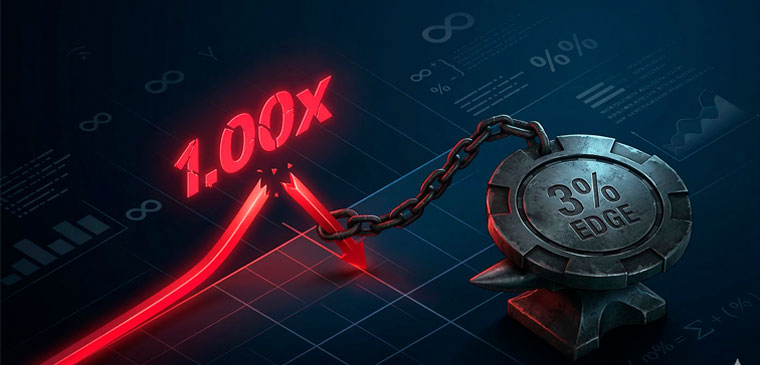
Aviator’s default RTP is 97%. This means the game returns $97 for every $100 wagered. The remaining $3 is the casino’s profit. This edge is not negotiable, not hidden, and not avoidable — it’s built into the algorithm that converts hashes to multipliers.
What does 3% feel like in practice?
| Scenario | Bet Size | Bets/Hour | Hourly Cost | 10-Hour Cost |
|---|---|---|---|---|
| Casual player | $0.50 | 60 | $0.90 | $9.00 |
| Regular player | $2.00 | 100 | $6.00 | $60.00 |
| Active player | $5.00 | 100 | $15.00 | $150.00 |
| High roller | $20.00 | 100 | $60.00 | $600.00 |
Use our Session Cost Calculator to calculate your exact expected cost. The 3% edge is moderate by casino standards — better than most slots (5%+) but worse than Bustabit or Stake Crash (both 1%). If your casino has configured Aviator to 94% RTP, double the costs in the table above.
Importantly: these are long-run averages. In any single session, you could win significantly or lose much more. The 3% edge only stabilizes over hundreds of bets. This is why short-term results feel random and why players often believe the game is rigged after a bad session.
Why Aviator Crashes at 1.00x (And Why It’s Not a Scam)
The most common trigger for “Aviator is rigged” complaints is the instant bust — a round where the multiplier crashes immediately at 1.00x, before anyone can cash out. This happens approximately 3% of the time with default 97% RTP settings.
This feels unfair, but it’s the only mechanism that makes the house edge work. Here’s why:
Without instant busts, every round would reach at least 1.01x. A player who always cashed out at 1.01x would win every single round, gaining a small profit each time with zero risk. Over thousands of rounds, they’d accumulate guaranteed profit. The casino would go bankrupt.
Instant busts are the mathematical price of the house edge. They ensure that no cashout target — not even 1.01x — is risk-free. The probability of an instant bust equals the house edge: 3% at 97% RTP, 1% at 99% RTP, 6% at 94% RTP.
If you’re seeing instant busts more frequently than expected, check the RTP setting. At 94% RTP, roughly 1 in 17 rounds will instant bust. At 97% RTP, it’s roughly 1 in 33. Both feel frequent during a session, especially due to confirmation bias — we remember the bad rounds more vividly than the average ones.
The Configurable RTP Problem
One legitimate concern about Aviator: different casinos can run it at different RTPs. Spribe allows operators to configure the game between 94% and 97%. This means:
| RTP Setting | House Edge | ~Instant Bust Rate | Cost/100 × $1 bets |
|---|---|---|---|
| 97% (default) | 3% | ~3 in 100 | $3.00 |
| 96% | 4% | ~4 in 100 | $4.00 |
| 94% | 6% | ~6 in 100 | $6.00 |
A casino running Aviator at 94% costs you twice as much per bet as one running it at 97%. This isn’t rigging — it’s a legitimate business configuration that should be transparently disclosed. But some casinos don’t make the RTP easy to find, which erodes trust.
How to check: In most Aviator implementations, click the “i” (info) or settings icon within the game interface. The RTP should be listed in the rules section. If it’s not there, you can estimate it: track 200+ rounds and count instant busts. If you see ~6% instant busts instead of ~3%, you’re likely playing at 94% RTP. Our RTP comparison guide shows which casinos typically run which settings.
What IS a Scam: Predictors, Hacks, and Fake Aviator Apps

While Aviator itself isn’t rigged, the ecosystem around it has plenty of scams targeting players who believe in rigging:
Aviator predictor apps. Apps and Telegram bots claiming to predict the next crash point are mathematically impossible. Aviator’s SHA-512 hash is a one-way function — you cannot derive future inputs from past outputs. These apps either show random predictions (which occasionally align with results by chance, reinforcing the scam) or steal your login credentials.
Fake Aviator games. Some unlicensed sites host visual clones of Aviator that aren’t connected to Spribe’s provably fair system at all. These can genuinely be rigged — they control the crash point directly without any cryptographic commitment. Always verify you’re playing the real Spribe game by checking the game info panel for Spribe branding and provably fair seed data.
“Guaranteed strategy” sellers. No strategy beats the house edge. The math proves it: expected value is negative at every cashout target, and the multiplier cancels out of the EV equation. Anyone selling a “winning system” is profiting from your purchase, not from the system.
Signal groups. Telegram and WhatsApp groups that share “signals” for when to bet are either scams (leading you to an affiliate link) or delusional (the signals have no mathematical basis). Past crash results contain zero information about future results — each round is independently generated.
When Something Might Actually Be Wrong
While Aviator’s algorithm is sound, the broader platform can have issues. These aren’t about the game being “rigged,” but they’re legitimate concerns:
Delayed cashouts. If the platform processes your cashout command with artificial delay (adding latency between your click and the server’s cashout confirmation), you’ll miss cashouts you should have made. This is a platform issue, not a game issue, but the effect is the same — you lose more.
Withdrawal problems. Provably fair only covers the game round. If the casino refuses to pay withdrawals, adds unreasonable wagering requirements, or blocks accounts after big wins, the fairness of individual rounds is irrelevant. Always check withdrawal policies before depositing.
Fake provably fair implementations. If you verify a hash and it doesn’t match, something is genuinely wrong. This has happened with unlicensed Aviator clones. The verification step is your defense — our hash verification guide shows exactly how to check.
Undisclosed RTP changes. If a casino switches from 97% to 94% RTP without notice, players experience worse odds without knowing why. This borders on deceptive practice. Regulated casinos are typically required to disclose RTP; unregulated ones may not.
Aviator’s Fairness vs. Other Crash Games
| Factor | Aviator | Bustabit | Stake Crash |
|---|---|---|---|
| Default RTP | 97% | 99% | 99% |
| Configurable RTP | Yes (94-97%) | No (fixed 99%) | No (fixed 99%) |
| Hash Function | SHA-512 | HMAC-SHA256 | HMAC-SHA256 |
| Client Input | 3 player seeds | Bitcoin block hash | Custom client seed |
| Open-Source | Partial | Yes (GitHub) | Published code |
| Instant Bust Rate | ~3% (at 97% RTP) | ~1% | ~1% |
| Cost/100 × $1 bets | $3.00 | $1.00 | $1.00 |
| Independent Audit | iTech Labs, GLI | Crypto Gambling Foundation | Platform-level |
Aviator is provably fair but has a higher house edge than most crypto-native crash games. The 3% vs 1% difference matters significantly over time — at 100 bets/hour with $2 stakes, Aviator costs $6/hour while Bustabit or Stake Crash cost $2/hour. For the full comparison of 18+ crash games by RTP, see our RTP guide.
The Bottom Line
Aviator is not rigged. Its provably fair system is cryptographically sound, audited by independent labs, and verifiable by any player. The crash point for each round is determined before bets are placed and cannot be altered afterward.
Aviator is designed to take your money — slowly. The 3% house edge guarantees the casino profits over time. This is the definition of every casino game. The difference is that Aviator’s edge is transparent and provable, which is more honest than most gambling games where the odds are a black box.
The real risks are around Aviator, not inside it: unlicensed clones, predictor scams, configurable RTP at unethical casinos, and platform-level withdrawal issues. Focus your skepticism on the casino, not the algorithm.
If you want to verify for yourself, our hash verification guide walks through the process step by step. If you want to understand the exact odds at each multiplier, the odds guide has the full probability tables. And if you want to compare Aviator’s cost to other options, the Session Cost Calculator shows the real hourly difference between 97% and 99% RTP games.
⚠️ Whether or not a game is rigged doesn’t change the fundamental reality: the house edge ensures you lose over time. If Aviator losses are causing financial stress, relationship problems, or anxiety, the game is costing more than money. Contact GambleAware or the National Council on Problem Gambling for confidential support.
Related Guides
- Aviator Review — complete game analysis including features, RTP, and strategy
- Hash Verification Guide — step-by-step: verify any Aviator round yourself
- Crash Game Algorithm Explained — how hash-to-multiplier conversion works
- Crash Game Odds — probability tables for every multiplier
- Crash Game RTP Comparison — where Aviator ranks vs 18+ games
- Bustabit Review — the open-source 99% RTP alternative
- Stake Crash Games — another 99% RTP option with provably fair
- Session Cost Calculator — see the real cost difference between 97% and 99% RTP
- Crash Game Software — which providers use provably fair vs certified RNG