

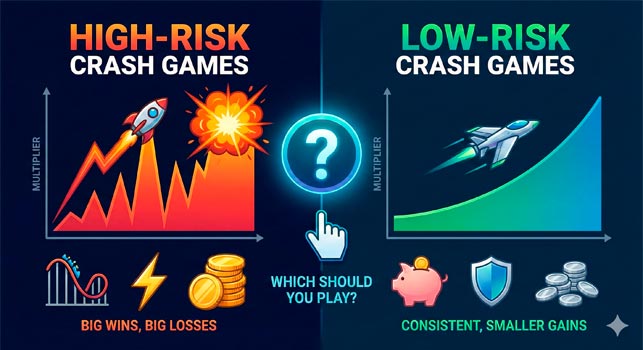
Every crash game has the same RTP regardless of how you play it. A 97% RTP game returns $97 per $100 wagered whether you cash out at 1.5x or 50x. What changes is the pattern — how those wins and losses distribute across your session. That pattern is volatility, and choosing between low-risk and high-risk play is the single biggest decision you make about your crash game experience.
This guide puts exact numbers on both approaches: win rates, losing streak lengths, bankroll requirements, and which games suit each style.
The Core Difference: Same RTP, Different Experience
97% RTP game:
1.5x target → 97/1.5 = 64.7% win rate
10x target → 97/10 = 9.7% win rate
50x target → 97/50 = 1.94% win rate
Both the 1.5x player and the 50x player have the same expected return per dollar bet ($0.97). But the 1.5x player wins most rounds for small amounts, while the 50x player loses most rounds and occasionally wins big. That’s volatility.
→ For the full formula breakdown, see our crash game algorithm guide.
Risk Profile Comparison
| Metric | Low Risk (1.5x) | Medium Risk (3x) | High Risk (10x) | Ultra-High (50x) |
|---|---|---|---|---|
| Win Rate (97% RTP) | ~65% | ~32% | ~10% | ~2% |
| Profit per Win ($1 bet) | $0.50 | $2.00 | $9.00 | $49.00 |
| Avg Losing Streak | 2-3 rounds | 4-6 rounds | 15-25 rounds | 50-100 rounds |
| Worst Likely Streak (per 500 rounds) | 5-6 rounds | 10-12 rounds | 30-40 rounds | 150+ rounds |
| Min Bankroll (in bets) | 50 bets | 100 bets | 200 bets | 500+ bets |
| Session Feel | Steady, predictable | Balanced swings | Long droughts, big spikes | Almost all losses, rare jackpots |
| Best For | Small bankrolls, beginners | Most players | Large bankrolls, thrill seekers | Streamers, jackpot hunters |
Low-Risk Play: The Grinder’s Approach
✅ What You Get
Win rate: ~65% at 1.5x target
Session length: Long — bankroll depletes slowly
Losing streaks: Short (2-3 rounds typical, 5-6 max)
Bankroll requirement: 50 bets minimum ($10 at $0.20/bet)
Emotional state: Calm, predictable, almost boring
⚠️ What You Give Up
Big wins: Capped at 0.5x profit per bet — no moonshots
Excitement: Low — the game becomes repetitive
Recovery speed: Slow — if you fall behind, grinding back takes many rounds
Illusion of safety: You still lose 3% long-term — it just happens gradually
Best Games for Low-Risk Play
| Game | RTP | Why It Suits Low Risk |
|---|---|---|
| BGaming Crash | 99% | Lowest house edge (1%) = slowest bankroll depletion. Best math for grinders. |
| Cash or Crash | 99.59% | Highest RTP available. 50x max isn’t a problem if you target 1.5x anyway. |
| Aviator | 97% | Dual bet lets you put one bet at 1.5x (safety) and one at a higher target (growth). |
High-Risk Play: The Jackpot Hunter’s Approach
✅ What You Get
Win size: 9-49x+ profit per winning round
Excitement: Intense — every round is a potential big hit
Recovery speed: One win erases 10-50 previous losses
Content potential: Great for streaming (dramatic wins)
⚠️ What You Give Up
Win frequency: ~10% at 10x, ~2% at 50x — mostly losing
Bankroll stability: Extreme drawdowns are normal
Session length: Short unless bankroll is very large
Emotional control: 25-round losing streaks test anyone’s discipline
The Losing Streak Reality
This is what high-risk play actually looks like over 20 rounds at a 10x target ($1 bet):
| Round | Result | P&L | Running Balance ($200 start) |
|---|---|---|---|
| 1-5 | 5 losses | -$5 | $195 |
| 6-10 | 5 losses | -$5 | $190 |
| 11-15 | 4 losses + 1 WIN (10x) | +$5 | $195 |
| 16-20 | 5 losses | -$5 | $190 |
| 21-25 | 5 losses | -$5 | $185 |
| 26-30 | 5 losses | -$5 | $180 |
| 31-35 | 4 losses + 1 WIN (10x) | +$5 | $185 |
| 36-50 | 14 losses + 1 WIN (10x) | -$5 | $180 |
After 50 rounds: 3 wins, 47 losses. Balance went from $200 to $180. Notice how winning 10x barely offsets the losses. The house edge grinds you down regardless of your target — high risk just makes the journey more dramatic.
Best Games for High-Risk Play
| Game | RTP | Max Multiplier | Why It Suits High Risk |
|---|---|---|---|
| BGaming Crash | 99% | 1,000,000x | Best math (1% edge) + highest possible max win. The go-to for serious high-risk play. |
| JetX | 97% | Unlimited | No multiplier cap at all. 3-bet system lets you hedge with a low-risk bet alongside. |
| Spaceman | 96.5% | 5,000x | 50% partial cashout lets you secure half your bet while letting the rest ride to 10x+. |
The Hybrid Approach: Splitting Your Bets
You don’t have to choose one style exclusively. Games with dual or triple bet features let you split risk within the same round.
Aviator dual bet example ($2 total per round):
Bet 1: $1.50 at auto-cashout 1.50x (low risk — wins ~65% of rounds, +$0.75 each win)
Bet 2: $0.50 at auto-cashout 10x (high risk — wins ~10% of rounds, +$4.50 each win)
The low-risk bet subsidizes the losing rounds, while the high-risk bet provides occasional big boosts. Your blended expected return is still ~97%, but the session feels less monotonous than pure low-risk and less punishing than pure high-risk.
JetX triple bet example ($3 total per round):
Bet 1: $1.50 at 1.5x (safety net)
Bet 2: $1.00 at 3x (medium growth)
Bet 3: $0.50 at 20x (moonshot)
→ For more on split strategies, see our strategy guide.
Switching Between Styles: Rules to Follow
When it’s OK to switch:
At the start of a new session with a fresh budget. If you planned a hybrid session from the beginning. If you want a change of pace and adjust your bet size accordingly.
The bet adjustment rule: When switching from low risk to high risk, divide your bet by at least 5. If you were betting $1 at 1.5x, bet $0.20 at 10x. This keeps your bankroll exposure roughly equal despite the higher variance.
Which Approach Fits Your Budget?
| Your Budget | Recommended Approach | Target Multiplier | Bet Size | Expected Session Length |
|---|---|---|---|---|
| $10-20 | Low risk only | 1.5x | $0.10-0.20 | 50-100 rounds |
| $50 | Low risk or hybrid | 1.5x / 2x | $0.25-0.50 | 50-100 rounds |
| $100 | Any approach | 1.5x – 5x | $0.50-1.00 | 50-100 rounds |
| $200+ | High risk viable | 5x – 10x | $1.00 | 100-200 rounds |
| $500+ | Ultra-high viable | 10x – 50x | $1.00-2.00 | 200+ rounds |
→ For exact bet sizing per budget, use our Bankroll Management Cheat Sheet. For RTP differences between games, see our comparison table. To practice both approaches risk-free, start in demo mode.
Frequently Asked Questions
What is volatility in crash games?
Volatility describes how a crash game distributes its payouts. Low volatility means frequent small wins (targeting 1.1x-2x). High volatility means rare large wins (targeting 10x-100x+). Both approaches have the same expected return (RTP) over time — what changes is the pattern of wins and losses within a session.
Is low risk or high risk better in crash games?
Neither is mathematically better — both have the same expected return per bet. Low risk is better for small bankrolls and longer sessions. High risk is better for large bankrolls and players seeking big single wins. See our bankroll guide for sizing your bets to your approach.
How long are losing streaks in high-risk crash play?
At a 10x target (~10% win rate), expect losing streaks of 15-25 rounds regularly. A 30+ round streak occurs about once every 500 rounds. At 50x (~2% win rate), 50-100 round losing streaks are normal. This is why high-risk play needs a bankroll of 200+ bets.
Should I switch from low risk to high risk after a losing streak?
No. Each round is independent — past losses don’t influence future results. Switching to high risk to chase losses usually accelerates bankroll depletion. Only switch at the start of a fresh session, and always reduce your bet size when moving to higher targets.
Which crash games are best for low-risk play?
BGaming’s Crash (99% RTP) gives the slowest bankroll depletion. Aviator’s dual-bet system lets you blend low and medium risk. Cash or Crash (99.59% RTP) offers the best mathematical edge. See our Aviator review for dual-bet details.
How much bankroll do I need for high-risk crash play?
At least 200 bets for a 10x target ($200 at $1/bet). For 50x targets, 500+ bets. If you can’t afford this, either lower your bet size or choose a lower multiplier target. See our bet sizing table for exact calculations.