

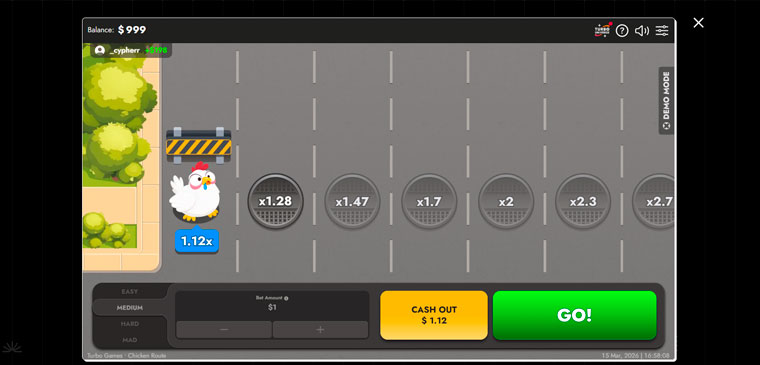
Chicken Route — Quick Facts
| Provider | Turbo Games (also makes Vortex, Crash X, Aero) |
| Released | October 8, 2025 |
| RTP | ~96% – 96.27% (per public game listings; full rule-sheet range not published by Turbo Games) |
| Cost/Hour ($1/bet, 80 rounds) | ~$3.00–$3.60 |
| Mechanic | Step-by-step — chicken crosses traffic lanes, cash out between steps |
| Difficulty Modes | 4: Easy (24 steps), Medium (22), Hard (20), Mad (18) |
| Max Multiplier | x1,000,000 (theoretical) |
| Max Win | $10,000 (casino capped) |
| Bet Range | $0.10 – $100 |
| File Size | Up to 2MB (ultra-lightweight) |
| Auto Cash-Out | ✅ |
| Provably Fair | ✅ |
Chicken Route is Turbo Games’ late 2025 entry into the chicken-crossing genre — and it shares the same core mechanic as InOut’s Chicken Road. Same animal, same step-by-step cash-out, same 4-difficulty structure. Released 18 months after InOut’s original, it arrives at a lower RTP: ~96% vs 98%.
In a category where every percentage point of RTP matters, Chicken Route costs roughly twice as much per bet as the game it closely resembles. This review explains what’s shared, what’s different, and why it matters for your wallet.
How Chicken Route Works
Chicken Route follows a step-by-step crash mechanic. You place a bet, choose one of four difficulty modes, and send a cartoon chicken onto a road full of traffic. Each step forward increases the multiplier. After every safe step, you choose: cash out and lock the current payout, or keep going for a higher multiplier. If the chicken gets hit — you lose the bet.
Key points:
- Round flow: Bet → choose difficulty → step forward → cash out or continue → round ends on hit or cash-out.
- Cash-out: Available between every step. No forced progression — you decide the exit point.
- Difficulty modes: Easy (24 steps, low risk per step), Medium (22), Hard (20), Mad (18 steps, highest risk, biggest multipliers). All modes share the same overall RTP range.
- Max win: Theoretical multiplier up to x1,000,000. In practice, casinos cap payouts — typically around $10,000 per round.
- Auto Cash-Out: Set a target multiplier and the game cashes out automatically when reached.
- Provably Fair: Each round outcome can be verified via cryptographic hash. Look for the verification option in the game menu.
- Where to check RTP: Open the game rules/info panel inside the casino client. The stated RTP may vary by operator — always verify before playing.
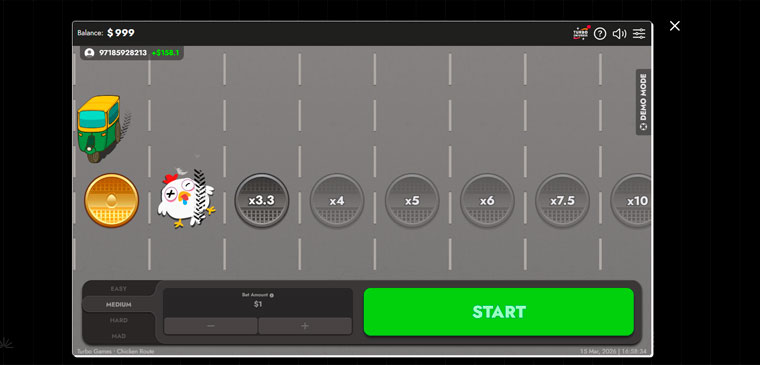
Chicken Route vs Chicken Road: Side-by-Side
| Feature | Chicken Route (Turbo Games) | Chicken Road (InOut) |
|---|---|---|
| RTP | ~96% – 96.27% | 98% |
| Cost/Hour ($1/bet) | $3.00–$3.60 | $1.60 |
| Character | Chicken | Chicken |
| Setting & Obstacles | Road with cars/traffic | Dungeon with manhole covers & flame traps |
| Difficulty modes | 4 (24/22/20/18 steps) | 4 (24/22/20/15 steps) |
| Cash-out | Between steps | Between steps |
| Max multiplier | x1,000,000 | x3,203,384.8 |
| Max win (casino cap) | $10,000 | $20,000 |
| File size | ~2MB | ~10MB |
| Released | Oct 2025 | Apr 2024 |
| Provably Fair | ✅ | ✅ |
The step counts are almost identical — only the highest-risk mode differs (Mad at 18 vs InOut’s Hardcore at 15). The character, core mechanic, difficulty count, and cash-out system are the same. The visual setting differs: Chicken Route uses a road/traffic theme, while the original Chicken Road is set in a dungeon with flame traps. Mechanically, Chicken Route is the same step-by-step chicken-crossing game with roughly double the house edge and a smaller file size.
Why Chicken Route Exists: Casino Distribution
The answer isn’t about better gameplay — it’s about business. InOut Games and Turbo Games distribute through different casino networks. A casino that has a Turbo Games integration but not InOut can offer Chicken Route to players who want the chicken-crossing mechanic. Players at those casinos have no choice between the two — they get whichever version their platform carries.
This is the same dynamic across the industry: Spaceman (Pragmatic, 95%) exists alongside Aviator (Spribe, 97%) because Pragmatic and Spribe distribute to different casinos. Same mechanic, different provider, different price. The player rarely gets to choose — the casino chooses for them.
Chicken Route’s ~2MB file size is its one genuine technical advantage — roughly five times smaller than most competing games. For casinos serving low-bandwidth regions (Africa, rural India, parts of Brazil), this matters. InOut’s Chicken Road is already lightweight, but Chicken Route is lighter still.
The Annual Cost of Playing the Higher-Edge Version
At $1/bet, 2 hours/week, 80 rounds/hour:
| Game | Annual Cost |
|---|---|
| Duel Beef | $67 |
| Chicken Road (InOut) | $166 |
| Chicken Route (Turbo Games) | $310–$359 |
| Chicken Road 2 (InOut) | $374 |
Chicken Route sits between Chicken Road (98%) and Chicken Road 2 (95.5%) in cost — but shares the same core gameplay mechanic. For essentially the same experience, the original saves you roughly $145–$190 per year.
What We Verified vs. What We Could Not
| Claim | Status | Source |
|---|---|---|
| Provider: Turbo Games | ✅ Verified | turbogames.io official site |
| Release: October 2025 | ✅ Verified | Turbo Games news page (08/10/2025) |
| 4 risk modes, 18–24 steps | ✅ Verified | Turbo Games official description |
| Lightweight client (~2MB) | ✅ Verified | Turbo Games official description |
| Provably Fair | ✅ Verified | Turbo Games official description |
| RTP 95.68%–96.27% | ⚠️ Partially | Widely cited in public game catalogs; Turbo Games’ full rule sheet not publicly accessible |
| Max multiplier x1,000,000 | ⚠️ Partially | Cited by multiple catalogs; not confirmed in official Turbo Games release notes |
| Max win $10,000 | ⚠️ Partially | Operator-set caps vary; $10,000 is common but not universal |
The Bottom Line
Chicken Route is a competent chicken-crossing game from a reputable provider. It works, it’s provably fair, and at ~2MB it’s the lightest version of this mechanic available. If your casino only offers Turbo Games titles, it’s a solid ~96% RTP step-by-step game.
But if you have any choice, Chicken Road (98%) delivers the same core mechanic for roughly half the cost. And if you can access Duel.com, Beef (99.2%) does it for a quarter the cost. Chicken Route’s primary value is distribution — reaching players at casinos that don’t carry InOut or Duel. The game itself closely resembles the original with a higher house edge.
⚠️ Responsible Gaming Note: Chicken Route’s similar look and feel to Chicken Road may lead players to assume the same RTP. It’s not — ~96% vs 98% means roughly double the house edge. No strategy — including step-counting, bet-size adjustments, or pattern-tracking — changes this mathematical reality. Always verify the provider name (Turbo Games vs InOut Games) and check the in-game rules for stated RTP before playing. Mad mode’s 18 steps with extreme multipliers can deplete bankrolls rapidly. Set strict stop-loss limits before opening the game. If gambling is causing problems, contact GambleAware or the National Council on Problem Gambling.
Related Reviews & Guides
- Chicken Road (InOut) Review — the 98% RTP original
- Duel Beef Review — 99.2% RTP road-crossing game
- Rabbit Road (InOut) Review — InOut’s own 95.5% variant
- Vortex (Turbo Games) Review — same provider, triple-element original
- Spire+ (Pragmatic Play) Review — step-by-step from tier-1 provider, 98%
- Crash Game RTP Comparison — all games ranked