

Balloon — Quick Facts
| Provider | SmartSoft Gaming (Tbilisi, Georgia — also makes JetX) |
| Released | June 2019 |
| RTP | 95.5–98% (operator-configurable). Most commonly cited: 96% |
| House Edge | 2–4.5% (typically 4% at 96% RTP) |
| Cost/Hour ($1/bet, ~70 rounds) | ~$2.80 at 96% RTP |
| Max Multiplier | ~10,000x (per public listings). Effective maximum depends on bet size and casino’s win cap. |
| Max Win | $10,000 (casino cap). At $100 max bet, this limits effective multiplier to 100x. At $1, up to 10,000x is theoretically reachable. |
| Bet Range | $0.10 – $100 (some operators may set lower max, e.g. $10) |
| Mechanic | Press-and-hold to inflate. Release to cash out. Pop = lose. |
| Provably Fair | ❌ No — certified RNG only (SmartSoft does not claim per-round cryptographic verification for Balloon) |
| Autoplay | ❌ No — manual hold required |
| Auto Cash-Out | ❌ Not available in most deployments (some sources report it may exist in certain operator versions) |
| Dual Bet | ❌ No |
| Disconnect Protection | ✅ Auto cash-out at current multiplier (min 1.01x) if connection drops |
| Social Features | ❌ Solo play only (SmartSoft lists Balloon as Single Player) |
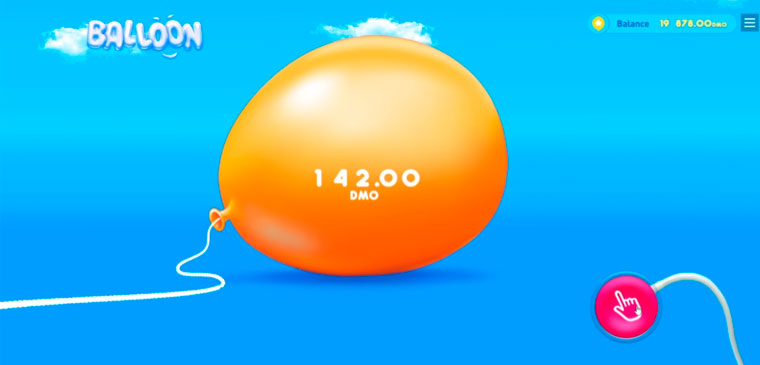
Balloon is SmartSoft Gaming’s crash-style game with a twist: instead of watching a multiplier rise and clicking “Cash Out,” you press and hold a button to physically inflate a balloon. Hold longer = higher multiplier. Release to cash out. If the balloon pops before you release — you lose everything.
It’s a genuinely different interaction model from Aviator or JetX (SmartSoft’s own more traditional crash game). The physical hold mechanic creates a distinctive tension: your finger is literally on the trigger at all times. But the math underneath is less favorable than most of its competitors — a 96% typical RTP with no Provably Fair verification, no autoplay, no dual bet, and a $10,000 win cap that restricts high-stakes players. Let’s break it down.
The Press-and-Hold Mechanic: What Makes Balloon Different
In standard crash games, you watch a multiplier rise and decide when to click Cash Out. The game runs at its own pace — you’re reacting. In Balloon, you’re controlling the inflation directly. You press a button, the balloon grows, the multiplier climbs, and you feel the tension in your held mouse button or touchscreen press. Release to win. Pop = lose.
This has several consequences:
No autoplay means built-in speed control — and that’s actually good. Because you must manually hold for every round, your natural pace is roughly 60–80 rounds per hour. You physically cannot run the 300+ rounds/hour that autoplay enables in Mines or Plinko. This built-in speed limit means Balloon’s hourly cost stays lower than it would with automation. The lack of autoplay aligns with the broader consumer-protection logic behind autoplay restrictions — forced manual engagement is a harm-reduction feature.
No auto cash-out means no safety net. In Aviator or Stake Crash, you can set auto cash-out at 2x and walk away — the server executes your exit automatically. Balloon doesn’t offer this in most deployments. Every round requires your continuous physical input. If your attention lapses, your finger slips, or your phone screen times out — you’re exposed. The only protection is disconnect auto-cashout (which triggers if your connection drops, not if you simply release late).
Color changes as a risk indicator. The balloon changes color as the multiplier increases — shifting through the spectrum as inflation progresses. This provides a visual cue that’s more intuitive than watching a rising number. Whether this helps or hurts decision-making depends on the player: visual cues can encourage timely exits or tempt you to chase “just one more color change.”
Solo play only. No other players visible, no shared multiplier, no chat. This is the opposite of Aviator’s multiplayer spectator-sport model.
RTP: 96% Is Below Average for Crash-Style Games
Balloon’s most commonly cited RTP is 96% (4% house edge). This puts it at a disadvantage against most crash games in the market:
| Game | RTP | House Edge | Rounds/Hr | Cost/Hour | Cost/Month (2hr/day) |
|---|---|---|---|---|---|
| Bustabit / Stake Crash | 99% | 1% | 90 | $0.90 | $54 |
| Aviator | 97% | 3% | 90 | $2.70 | $162 |
| JetX (SmartSoft) | ~97% (official: 96.2–98.9%) | ~3% | 90 | $2.70 | $162 |
| Balloon (SmartSoft) | 96% | 4% | ~70* | $2.80 | $168 |
| Spaceman | 96.5% | 3.5% | 90 | $3.15 | $189 |
Balloon’s hourly cost ($2.80) is comparable to Aviator and JetX despite the higher house edge — because its manual-only mechanic naturally slows play to ~70 rounds/hour vs ~90 for autoplay-enabled games. But if you could play Balloon at Aviator’s speed, it would cost $3.60/hour — 33% more.
The configurable RTP (95.5–98%) adds another layer of uncertainty. Some casinos may run Balloon at 95.5% (4.5% edge) without disclosing this prominently. Always check the in-game info panel for the actual RTP at your platform.
A note on SmartSoft’s own lineup: SmartSoft makes both Balloon (96% typical) and JetX (96.2–98.9% RTP per SmartSoft official specs, commonly cited as ~97%). JetX has better RTP, auto cash-out, dual bet, and wider availability. If you’re choosing between SmartSoft games, JetX is the mathematically superior option.
Where Balloon Falls Short
Below-average RTP with no transparency guarantee. 96% typical RTP is lower than Aviator (97%), JetX (~97%), and vastly lower than Bustabit/Stake Crash (99%). The configurable range (95.5–98%) means your actual cost could be even worse, and without Provably Fair verification you can’t independently confirm the setting.
No Provably Fair. SmartSoft uses certified RNG — meaning third-party labs have tested the randomness. But you cannot verify individual rounds yourself. By comparison, Spribe (Aviator), Bustabit, Stake, and BC.Game all offer per-round cryptographic verification. If fairness transparency matters to you, Balloon falls short. See our Provably Fair explainer for what strong verification looks like.
$10,000 win cap limits high-stakes play. The theoretical max multiplier per public listings is ~10,000x — but all wins are capped at $10,000. This means a $100 bet can only realistically return 100x (= $10,000), while a $1 bet could theoretically reach 10,000x. Games like Stake Crash (1,000,000x theoretical) offer dramatically higher ceilings for low-stakes players chasing outlier wins.
Missing features that competitors include. No dual bet (Aviator and JetX have it). No auto cash-out in most deployments. No autoplay. No betting scripts (Bustabit has it). No social features. Balloon is feature-sparse compared to the market.
What Balloon Does Well
Genuinely distinctive interaction. The press-and-hold mechanic is unlike any other crash game. It creates a physical connection to the game that clicking a button doesn’t replicate. There’s a tangible sensation of “holding on” that mirrors the risk you’re taking.
Visual progression is intuitive. The balloon’s growing size and changing colors provide immediate, visceral feedback about your risk level. You don’t need to read a number to understand that the balloon is about to pop.
Built-in speed control. No autoplay means no runaway sessions. Your physical engagement is required for every round.
Disconnect protection exists. If your connection drops mid-round, the game auto-cashes you out at the current multiplier (minimum 1.01x).
Low minimum bet. At $0.10 minimum, Balloon is accessible for casual play and bankroll-limited players.
The Bottom Line
Balloon is worth trying for its press-and-hold mechanic alone — it’s a genuinely different physical experience from standard crash games, and the balloon-inflation visual feedback is more intuitive than watching numbers rise. The lack of autoplay is ironically healthy for bankroll management.
But the numbers don’t favor it. At 96% typical RTP, Balloon costs more per bet than Aviator, JetX, and every 99% RTP alternative. The absence of Provably Fair verification, auto cash-out, and social features means you’re paying a higher house edge for fewer features. SmartSoft’s own JetX offers better RTP with more tools at the same provider.
If the press-and-hold mechanic appeals to you and you play casually (low bets, short sessions), Balloon delivers a unique experience. If you optimize for cost, transparency, or feature set, almost any other crash game on the market is a better deal.
⚠️ Responsible Gaming Note: Balloon’s press-and-hold mechanic creates a visceral connection between your physical action and the outcome. This can intensify both the excitement of winning and the frustration of losing. The absence of auto cash-out means you have no safeguard against hesitation or “chasing colors.” Set a strict loss limit before each session. If you find yourself holding longer than your plan because of emotional pressure, take a break. If gambling is causing problems, contact GambleAware or the National Council on Problem Gambling.
Related Reviews & Guides
- JetX Review — SmartSoft’s ~97% RTP crash game (better value from the same provider)
- Aviator Review — Spribe’s 97% RTP benchmark crash game
- Bustabit Review — 99% RTP, Provably Fair, open-source
- Stake Crash Review — 99% RTP with auto cash-out and social features
- Spaceman Review — Pragmatic Play’s 96.5% RTP crash game
- Crash Game RTP Comparison — all games ranked by cost
- Provably Fair Explained — what Balloon is missing
- Session Cost Calculator — your exact hourly cost