

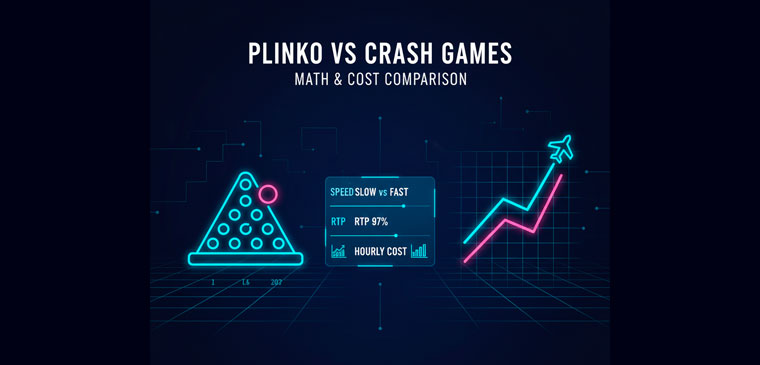
Plinko and crash games are the two fastest-growing instant game categories in online casinos. They share a lot: both are simple, fast, Provably Fair (often), and popular in the same markets. But they work very differently — and the differences matter for your wallet.
This comparison uses the numbers that actually matter: house edge, rounds per hour, real hourly cost, the type of player decisions, and volatility control. We’re not here to tell you one is “better” — we’re here to show what each costs and how they differ so you can choose based on data.
The Core Comparison: Plinko vs Crash at a Glance
| Dimension | Plinko | Crash Games |
|---|---|---|
| RTP Range | 97–99% (provider-dependent) | 94–99% (provider-dependent) |
| Best Available RTP | 99% (BGaming, Stake, BC.Game) | 99% (Bustabit, Stake, BC.Game) |
| Most Common RTP | 97% (Spribe Plinko) | 97% (Aviator, JetX) |
| Speed (rounds/hr) | 100–600+ (turbo/instant) | 80–100 (animation paced) |
| Player Decision | Pre-round: risk level, rows, bet | Mid-round: when to cash out |
| Decision Affects Outcome? | Changes variance, not EV | Changes variance, not EV |
| Volatility Control | Explicit: low/medium/high + rows | Implicit: cashout target |
| Max Multiplier | 555x–3,843x (varies by provider) | 100x–1,000,000x (varies by provider) |
| Social Features | Minimal (solo play) | Multiplayer (live bets, chat) |
| Provably Fair | Yes (BGaming, Spribe, Stake) | Yes (Bustabit, Stake, BC.Game, Spribe) |
| Autoplay Risk | High — turbo/instant can burn bankroll fast | Moderate — 5-sec pauses slow natural pace |
| Skill Factor | None | None |
The striking result: at the same RTP from the same providers (BGaming, Spribe, Stake, BC.Game), Plinko and crash games have identical expected cost per bet. The difference is entirely in speed, decision type, and volatility control.
House Edge by Provider: Same Companies, Same Math
Many providers make both Plinko and crash games. This table shows how their RTPs compare:
| Provider | Plinko RTP | Crash RTP | Difference |
|---|---|---|---|
| BGaming | 99% | 99% (Space XY) | Equal |
| Stake (in-house) | 99% | 99% (Crash) | Equal |
| BC.Game (in-house) | 99% | 99% (Classic Crash) | Equal |
| Spribe | 97% | 97% (Aviator) | Equal |
The pattern is clear: providers set the same house edge across their instant game lineup. If a provider offers 99% crash, their Plinko is typically 99% too. If Spribe charges 3% on Aviator, their Plinko charges 3% as well. The game type doesn’t determine the cost — the provider does. Our RTP comparison covers the crash side in detail.
Speed: Where Plinko Gets Dangerous
This is where the comparison gets important. Your hourly cost formula is always:
Hourly cost = house edge × bet size × rounds per hour
Crash games have a natural speed limiter: the multiplier animation takes several seconds to rise, and there’s typically a 5-second pause between rounds. This keeps the pace at roughly 80-100 rounds per hour, even with autobet enabled.
Plinko has no such constraint. With turbo mode, the ball drop animation is near-instant. With “instant” mode (available in some versions), you skip the animation entirely and see only the result. Autoplay can run 10-20 drops per minute without pausing. At maximum speed, Plinko can run 300-600+ rounds per hour.
| Game / Mode | Rounds/Hour | Cost/Hour | Cost/Month (2hr/day) |
|---|---|---|---|
| Crash game (normal pace) | 90 | $0.90 | $54 |
| Plinko (manual drops) | 120 | $1.20 | $72 |
| Plinko (autoplay, normal speed) | 300 | $3.00 | $180 |
| Plinko (turbo/instant autoplay) | 600 | $6.00 | $360 |
At the same 99% RTP and $1/bet, Plinko on turbo autoplay costs $6/hour vs crash’s $0.90/hour. That’s a 6.7x difference — not from a worse house edge, but from raw speed. This is the same dynamic that makes slots the most expensive casino game despite sometimes having reasonable RTP. Speed kills bankrolls.
The takeaway: if you play Plinko, your most important decision is how fast you play, not which risk level you choose. Use the Session Cost Calculator to see the impact of speed on your specific numbers.
Player Decisions: Pre-Round vs Mid-Round
This is the fundamental experiential difference between the two games:
Crash games give you a real-time decision: the multiplier is rising and you choose when to cash out. This creates tension, adrenaline, and the feeling of active participation. You watch the number climb, your heart rate rises, and you decide. It’s a timing decision under pressure.
Plinko gives you pre-round decisions: choose your risk level (low/medium/high), number of rows (8-16), and bet size. Then you drop the ball and watch. Once the ball is released, you have zero control. The outcome is determined by physics simulation (or RNG) and you observe it.
Does this matter mathematically? No. In both games, player decisions change variance (the distribution of wins and losses) but not expected value (the long-term cost). Cashing out at 2x in a crash game and playing Plinko on medium risk produce different experiences with the same long-term cost rate. The odds guide proves this for crash games; the same principle applies to Plinko.
Does this matter psychologically? Yes, significantly. The real-time cashout decision in crash games creates a sense of agency that Plinko lacks. This can be positive (engagement, excitement) or negative (regret when you cash out “too early”, tilt when you miss a big multiplier). Plinko’s pre-set approach removes mid-game emotional decisions, which some players find healthier for bankroll management.
Volatility Control: Explicit vs Implicit
Both games let you adjust how “swingy” your session is, but through different mechanisms:
Plinko’s explicit controls: Risk level (low = frequent small wins, high = rare large wins) and row count (more rows = more extreme distribution). These settings directly map to a payout table you can see before playing. You know exactly which multipliers are possible and their approximate probabilities before you drop the ball. This is transparent and structured.
Crash game’s implicit control: Your cashout target determines your volatility. Cashing out at 1.5x gives you ~65% win rate with small profits. Waiting for 10x gives you ~10% win rate with larger payouts. The relationship between target and probability follows the formula P = RTP / multiplier (detailed in our odds guide). This is less visible than Plinko’s explicit settings but more continuously adjustable.
Neither approach changes the house edge. They’re different interfaces for the same mathematical concept: choosing your position on the risk-reward spectrum.
Maximum Win Potential
For players who care about the theoretical maximum payout, crash games generally win this comparison:
Crash games: Stake Crash and BC.Game Crash allow multipliers up to 1,000,000x. Even Aviator at 100x offers substantial max win potential. Bustabit‘s max win is 1% of the site’s bankroll — potentially very large.
Plinko: Maximum multipliers are constrained by the board geometry. BGaming Plinko tops out around 1,000x. Spribe Plinko caps at ~555x. Hacksaw Gaming’s version reaches 3,843x. These are large but orders of magnitude below crash game maximums.
However, maximum multipliers are misleading. A 1,000,000x payout on a crash game has a probability of roughly 0.0001% per round — you’d need to play about a million rounds (at 100/hour, that’s ~10,000 hours or 14 years of daily play) to have a reasonable chance of seeing it once. The practical max win — what you might realistically see in months of play — is more similar between the two game types.
Social Features: Multiplayer vs Solo
Crash games are inherently multiplayer. Everyone in the room sees the same multiplier rising, watches other players cash out, and experiences the crash together. Games like Aviator add live chat, bet feeds, and “rain” features. This creates a social, spectator-sport dynamic that many players value.
Plinko is almost entirely a solo experience. You drop your ball, watch it bounce, see the result. There’s no shared multiplier, no other players visible, no tension about whether someone else will cash out before you. It’s meditative where crash is social.
This isn’t about which is “better” — it’s about what you want from a gaming session. Some players find crash games’ social pressure leads to poor decisions (cashing out because others did, or holding too long to beat the chat). Others find the social element is the whole point.
The Bottom Line: Which Should You Play?
If you optimize for lowest cost: Pick either game at 99% RTP. BGaming Plinko, Stake Plinko, Stake Crash, BC.Game Crash, and Bustabit all offer 1% house edge. Then control your speed — especially in Plinko, where autoplay can multiply your hourly cost 3-6x.
If you want real-time decisions and social tension: Crash games. The cashout timing mechanic and multiplayer feed create an experience Plinko can’t replicate.
If you want structured, pre-set volatility control: Plinko. Choosing risk level and rows before each round is more methodical than making split-second cashout decisions under pressure.
If you’re prone to emotional decisions: Plinko may be healthier. No mid-round decision means no “I should have held longer” regret. Set your risk, drop the ball, accept the outcome.
The universal rule for both: House edge × bet × rounds = your cost. The game type doesn’t determine your losses — the RTP, bet size, and session length do. Everything else is entertainment preference.
Related Guides
- Crash Game RTP Comparison — all crash games ranked by house edge
- Crash Game Odds — probability tables for every multiplier
- Crash Games vs Other Casino Games — the wider comparison (slots, blackjack, roulette)
- Aviator Review — the most popular 97% RTP crash game
- Bustabit Review — the 99% RTP open-source crash game
- Stake Crash Review — 99% RTP crash + Plinko on one platform
- BC.Game Crash Review — 99% RTP crash + Plinko on one platform
- Session Cost Calculator — calculate your exact hourly cost for any game
- Crash Game Algorithm — how crash points are generated
- Provably Fair Explained — verification systems for both game types