

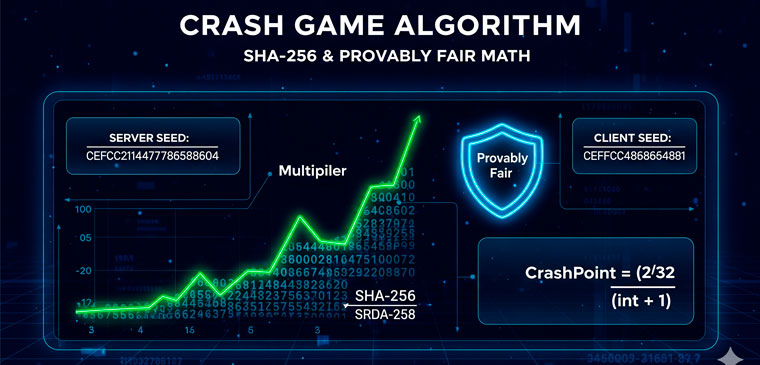
Most articles about crash game algorithms give you vague explanations like “it uses SHA-256” without showing you what that actually means. This guide is different. We walk through the exact process — from seed generation to crash point calculation — with real pseudocode based on published implementations from major platforms. By the end, you’ll understand precisely how a hash becomes a multiplier and why prediction is mathematically impossible.
Who this is for: Players who want to understand the technology behind Provably Fair crash games. You don’t need to be a programmer, but we won’t shy away from the technical details — they’re the whole point. For a non-technical overview of crash game mechanics, see our How Crash Games Work guide.
The Big Picture: 5 Steps to a Crash Point
Every Provably Fair crash game follows the same general process, regardless of provider. The specific implementation varies, but the architecture is consistent:
Step 1: Generate a Hash Chain (Before Any Games Are Played)
The operator starts with a secret seed and hashes it through SHA-256 millions of times, creating a chain. Game 1 uses the last hash in the chain, game 2 uses the second-to-last, and so on — working backwards. This means every future game result exists before a single bet is placed.
Step 2: Publish the Terminating Hash (Proof of Commitment)
The operator publishes the final hash in the chain (the one used for game 1) so anyone can later verify the entire chain was pre-generated. Some operators publish this on a blockchain for immutable proof of existence.
Step 3: Combine with Client Seed (Proof of Player Influence)
The game hash is combined with a client seed — either provided by the player, generated by the browser, or derived from an external source the operator cannot control (like a future Bitcoin block hash). This ensures the operator couldn’t have rigged the chain to produce favorable results.
Step 4: Convert Hash to Number
The combined hash (a 64-character hexadecimal string) is partially converted to a decimal number. Different implementations use different portions of the hash — some use the first 8 hex characters (32 bits), others use 13 characters (52 bits).
Step 5: Apply the Crash Point Formula
The number is plugged into a formula that produces the crash multiplier. The house edge is a parameter in this formula — it mathematically reduces every result by a fixed percentage.
The Hash Chain: Pre-Generating Millions of Game Results
Before a single player bets, the operator generates the entire sequence of future games. Here’s how:
secret = random_64_hex_string()
hash = secretfor i = 1 to 10,000,000:
hash = SHA256(hash)// The last hash produced is the “terminating hash”
// Publish this hash publicly BEFORE any games are played
publish(hash) // e.g., post on blockchain
// Games are played in REVERSE order:
// Game 1 uses hash #10,000,000 (the published one)
// Game 2 uses hash #9,999,999
// Game 3 uses hash #9,999,998
// …and so on
The critical insight: because SHA-256 is a one-way function, knowing hash #10,000,000 does not let you calculate hash #9,999,999. But after game 2 is played and hash #9,999,999 is revealed, anyone can verify that SHA-256(hash #9,999,999) = hash #10,000,000. This is how the entire chain is verifiable after the fact but unpredictable in advance.
Each hash in the chain can be independently verified by checking that SHA-256 of one hash produces the next hash in the sequence. If any hash doesn’t chain correctly, the entire chain is invalid — proving the operator tampered with results.
The Client Seed: Removing Operator Control
The hash chain alone has a weakness: the operator chose the initial secret, so they could have brute-forced a chain that produces favorable (low) crash points. The client seed solves this.
By combining the game hash with a seed the operator cannot predict or control, the final crash point becomes unpredictable to both parties. Different crash games handle this differently:
| Game / Platform | Client Seed Source | How Combined |
|---|---|---|
| Stake Originals | Player-set string + nonce | HMAC-SHA256(serverSeed, clientSeed:nonce:cursor) |
| Aviator (Spribe) | Seeds from first 3 players to bet | SHA-512(serverSeed + clientSeed1 + clientSeed2 + clientSeed3) |
| Bustabit / Classic | Future Bitcoin block hash | HMAC-SHA256(gameHash, blockHash) |
| BC.Game | Player-set string + nonce | HMAC-SHA256(serverSeed, clientSeed:nonce) |
Aviator’s approach is notable: it uses seeds from the first 3 players who bet in each round. This means the crash point literally doesn’t exist until those players place their bets — neither the operator nor any individual player can know or control the result.
The Formula: From Hash to Crash Point
This is the core of the algorithm — the part most articles skip. There are two main formula families used in production crash games:
Formula A: The “2^32” Method (Stake, BC.Game)
// Take the first 8 hex characters
hex8 = hash[0:8]// Convert to a 32-bit integer
int = hexToDecimal(hex8) // Range: 0 to 4,294,967,295 (2^32 – 1)// Apply the crash point formula
houseEdge = 0.01 // 1% edge = 99% RTP
crashPoint = max(1, (2^32 / (int + 1)) * (1 – houseEdge))
// Example: hex8 = “a3bf29c1”
// int = 2,747,600,321
// crashPoint = max(1, (4,294,967,296 / 2,747,600,322) * 0.99)
// crashPoint = max(1, 1.5632 * 0.99)
// crashPoint = 1.55 (rounded to 2 decimal places)
The max(1, ...) ensures the crash point is always at least 1.00× (the game crashes instantly). The house edge multiplier (1 - houseEdge) scales down every result. For a 3% house edge (97% RTP, like Aviator), you’d use 0.97. For a 1% edge (99% RTP, like Stake Crash), you’d use 0.99.
Formula B: The “52-Bit” Method (Bustabit, Classic Crash)
// Take first 13 hex characters (52 bits)
hex13 = hash[0:13] int52 = hexToDecimal(hex13) // Range: 0 to 2^52 – 1// Instant crash check: ~1% of games crash at 1.00x
if hash is divisible by 101:
return 1.00 // Instant crash (house edge mechanism)// Convert to crash point
e = 2^52
crashPoint = floor((100 * e – int52) / (e – int52)) / 100
// The “divisible by 101” check creates ~0.99% instant crashes
// This is how the house edge is enforced in this formula
In this variant, the house edge is enforced differently: instead of multiplying the result by (1 - houseEdge), approximately 1 in 101 games crashes instantly at 1.00×. This creates an effective house edge of about 1% over many rounds. The approach is mathematically equivalent but mechanically different — players occasionally see instant crashes where no one can win.
How the House Edge Is Baked Into the Math
This is the part many players don’t understand: the house edge is not a secret manipulation — it’s a visible parameter in the formula. Changing the house edge changes the RTP:
| House Edge Parameter | RTP | Cost per $100 Wagered | Used By |
|---|---|---|---|
| 0.01 (1%) | 99% | $1.00 | Stake, BC.Game, Roobet originals |
| 0.03 (3%) | 97% | $3.00 | Aviator (Spribe), JetX (SmartSoft) |
| 0.04 (4%) | 96% | $4.00 | Spaceman (Pragmatic), Balloon (SmartSoft) |
| 0.05 (5%) | 95% | $5.00 | F777 Fighter (OnlyPlay) |
The formula crashPoint = (2^32 / (int + 1)) * (1 - houseEdge) means the house edge literally multiplies every potential crash point by 0.97 (for a 3% edge). A “true” 2.00× crash point becomes 1.94× after the 3% reduction. Over millions of rounds, this guarantees the operator profits exactly the house edge percentage on total wagered amounts.
Key insight: The house edge is not applied randomly or selectively — it’s a constant multiplier on every single round. There are no “cold streaks” or “hot streaks” built into the algorithm. Each round is independently calculated from its own hash.
Why Prediction Is Mathematically Impossible
Let’s be precise about why “crash predictor” apps cannot work. It’s not just “difficult” — it’s equivalent to breaking all modern cryptography.
The One-Way Function Problem
SHA-256 is a cryptographic hash function — you can compute the hash of any input instantly, but you cannot work backwards from the hash to find the input. This is called a “one-way function.” The crash point is determined by the hash, and you only see the hash after the round ends. Before the round, you only see the hash of the hash (the commitment), which tells you nothing about the underlying value.
The Client Seed Barrier
Even if you somehow knew the game hash in advance (which you don’t), you still wouldn’t know the client seed. In Aviator, the client seeds come from other players who haven’t bet yet. In Bustabit-style games, the client seed is a future blockchain block hash that doesn’t exist yet. The crash point is a function of both seeds — knowing one without the other is useless.
The Scale of SHA-256
SHA-256 produces 2^256 possible outputs — that’s approximately 1.16 × 10^77 possibilities. For perspective, the number of atoms in the observable universe is estimated at approximately 10^80. If every atom in the universe were a computer running billions of hash calculations per second, they would not brute-force SHA-256 before the heat death of the universe.
Every “crash predictor” app is a scam. If someone could predict crash points, they could also break Bitcoin, empty every cryptocurrency wallet on Earth, decrypt classified government communications, and compromise every bank’s security system. The fact that none of these things have happened is proof that crash games cannot be predicted. If you’ve downloaded a “predictor” app, it’s either stealing your data, installing malware, or taking your money for a fake subscription.
Provably Fair vs Certified RNG: What’s the Difference?
Not all crash games use Provably Fair. Some use certified RNG instead. Here’s the distinction:
| Feature | Provably Fair | Certified RNG |
|---|---|---|
| Player verification | Yes — verify every round yourself | No — trust the lab’s certification |
| Third-party audit | Optional (verification is built-in) | Required (eCOGRA, GLI, iTech Labs) |
| Algorithm transparency | Seeds and hashes visible to player | Black box — algorithm hidden |
| Regulatory acceptance | Accepted by Curacao, some others | Accepted by UKGC, MGA, all major regulators |
| Trust model | Trustless (verify, don’t trust) | Trust-based (trust the lab and regulator) |
| Used by | Stake, BC.Game, Aviator (Spribe), JetX | Spaceman (Pragmatic Play), Evolution games |
For crash games specifically, Provably Fair is the stronger standard because it gives you round-by-round verification. Certified RNG is adequate — the testing labs are reputable — but you’re trusting the certification rather than verifying it yourself. For a practical guide on how to verify Provably Fair results, see our Provably Fair Verification Guide.
How to Verify a Round Yourself
The general verification process is the same across all Provably Fair crash games. Here are the steps:
During the game: Before the round starts, note the hashed server seed displayed in the game’s fairness panel. Optionally, set your own client seed (this is your “influence” on the result).
After the round: The game reveals the unhashed server seed. You now have all three inputs: server seed, client seed, and nonce (round number).
Verify the commitment: Run SHA-256 on the revealed server seed. The output must match the hashed server seed you saw before the round. If it doesn’t match, the operator changed the seed mid-round — the game was rigged.
Verify the result: Combine the server seed, client seed, and nonce using the game’s specified method (usually HMAC-SHA256). Convert the output to a crash point using the game’s formula. The result must match the crash point you saw in the game.
You can use any independent SHA-256 or HMAC-SHA256 tool to perform these checks — you don’t need to trust the game’s own verification tool. If the math checks out with an external tool, the round was fair.
What About Pattern-Based Strategies?
Some players analyze hundreds or thousands of past crash points looking for patterns. Here’s why this doesn’t work:
Statistical independence: Each round’s crash point is derived from a unique hash. The hash for round 500 has no mathematical relationship to the hash for round 499, 498, or any other round. This is not a claim — it’s a property of SHA-256 that has been studied extensively by cryptographers for decades.
The Gambler’s Fallacy: “The last 10 rounds crashed below 2×, so a high crash must be coming.” This is false. The probability of the next crash point being above 2× is exactly the same regardless of what happened in previous rounds. The algorithm has no memory — it doesn’t track or compensate for past results.
Distributional patterns are expected: Over thousands of rounds, you’ll see approximately 3% of rounds crash at 1.00× (for a 3% house edge), about 50% crash below 2×, and about 10% exceed 10×. These are not “patterns” — they’re the mathematical distribution built into the formula. They tell you nothing about what will happen in the next round. Our Multiplier Probability Calculator shows the exact distribution for any RTP setting.
Bottom Line
The crash game algorithm is an elegant piece of cryptography. A pre-generated hash chain ensures every result is committed before bets are placed. Client seeds ensure the operator can’t rig the chain. The crash point formula converts a hash into a multiplier with a built-in house edge. And SHA-256 makes the entire system both verifiable (after the fact) and unpredictable (before the fact).
Understanding this algorithm won’t help you win — the math is designed to ensure the house profits over time. But it does help you verify that the game is fair, identify games that aren’t provably fair, and dismiss the predictor scams that prey on players who don’t understand the technology.
Related Guides and Tools
- How Crash Games Work — non-technical overview of crash game mechanics
- Provably Fair Verification Guide — step-by-step verification for Aviator, Stake, and more
- Crash Game RTP Guide — how the house edge parameter affects your wallet
- Multiplier Probability Calculator — see the exact crash point distribution for any RTP
- Session Cost Calculator — calculate what any house edge costs per hour
- How to Choose a Crash Gambling Site — 10-point checklist including Provably Fair verification