

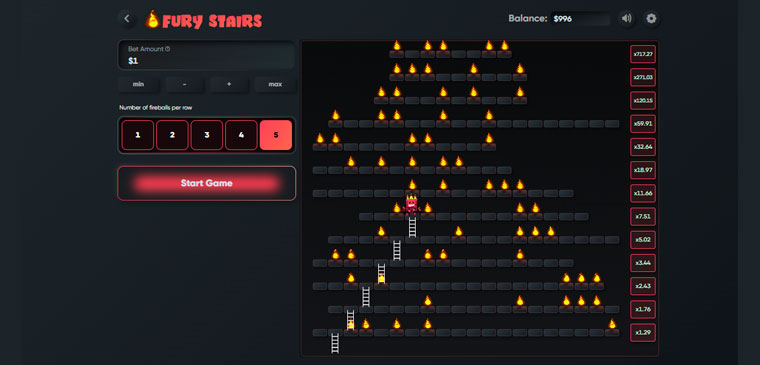
Fury Stairs — Quick Facts
| Provider | Turbo Games |
| Released | December 2021 |
| RTP | 97% |
| Cost/Hour ($1/bet, 80 rounds) | ~$2.40 |
| Mechanic | 13-row climb — choose a position on each row, avoid hidden hazards, cash out anytime |
| Hazards Per Level | Multiple difficulty settings (per CrashBetz: 1–5 fireballs per level, producing 5 distinct multiplier scales) |
| Max Multiplier | 717.27x (5 hazards, all 13 rows cleared) |
| Max Win | $10,000 cap reported by CrashBetz (verify in live client — official page confirms only the 717.27x multiplier) |
| Bet Range | $0.10 – $100 (per CrashBetz; may vary by operator) |
| Provably Fair | ✅ Yes (per Turbo Games) |
| Character | Red «Meat Boy»-style figure navigating flaming obstacles |
| Historical Note | Released Dec 2021 — well before Chicken Road (Apr 2024) and Spire+ (Feb 2026) |
Fury Stairs is Turbo Games’ climb-and-cash-out title — a 13-row obstacle course where a red character must navigate past hidden fireballs to reach the top. You choose the difficulty before each round (1–5 hazards per row), pick a position on each level, and cash out whenever your nerve breaks. Hit a fireball, and you lose everything. Reach the top at maximum difficulty, and you walk away with 717.27x your bet.
Released in 2021, this is one of the earliest games in the climb-and-cash-out genre — the same mechanic that Chicken Road later popularized and Spire+ refined. It predates InOut’s breakout hit by over two years and Pragmatic Play’s entry by over four. The visuals are rough by 2026 standards, but the 5-grade difficulty system remains among the most granular in the category.
How the 13-Row Climb Works
Each round follows the same structure: set your bet ($0.10–$100), choose the number of hazards per level (1–5), and start climbing. On each of the 13 floors, you pick a position. If the position is safe, you advance and your multiplier increases. If the position hides a fireball, the round ends and your bet is lost.
You can cash out between any two levels — this is the core tension. Each step forward is a voluntary decision to risk your accumulated winnings for a higher multiplier. The game is provably fair: outcomes are hash-verifiable, meaning you can confirm the hazard placement after each round.
CrashBetz reports a $10,000 payout cap — meaning that even at $100 max bet × 717.27x, the theoretical $71,727 would be reduced to $10,000. This cap is not confirmed on Turbo Games’ official page (which lists only the 717.27x multiplier), so verify the actual ceiling in the live client at your casino before placing high bets.
5 Difficulty Grades: The Multiplier Table
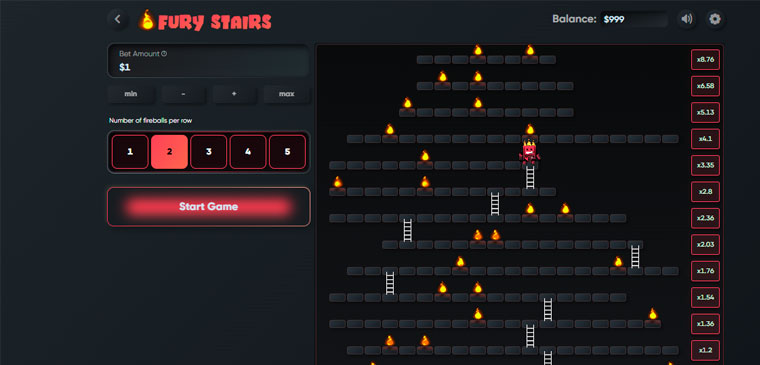
The game’s strongest feature is its transparent, player-selectable difficulty. Five distinct settings produce radically different risk/reward profiles:
| Hazards/Row | Row 1 | Row 13 (Max) | Survival Probability |
|---|---|---|---|
| 1 | 1.02x | 2.77x | ~51% (all 13 rows) |
| 2 | 1.08x | 8.60x | ~25% |
| 3 | 1.14x | 31.71x | ~10% |
| 4 | 1.21x | 134.85x | ~3.5% |
| 5 | 1.29x | 717.27x | ~0.9% |
Multiplier values sourced from CrashBetz, which lists the exact progression for each difficulty setting. The 717.27x maximum is also confirmed on Turbo Games’ official page. Note: the multiplier scale implies a dependent-probability model (similar to Mines), not independent rows — meaning hazard positions may be drawn from a shared pool rather than being independently random on each level. The exact internal RNG mechanic is not publicly documented by Turbo Games.
Compare: Chicken Road has 4 difficulty modes. Spire+ has 5. This game matches Spire+ on granularity, and the exact multiplier progression per floor is transparently published — a genuine advantage for players who want to calculate risk precisely before each round.
The Genre This Game Helped Build
| Game | Provider | Released | RTP | Rows | Max Mult |
|---|---|---|---|---|---|
| Towers / Fury Stairs | Turbo Games | 2021 | 95–97% | 13 | 717x |
| Chicken Road | InOut Games | Apr 2024 | 98% | 15–24 | ~3.2Mx |
| Spire+ | Pragmatic Play | Feb 2026 | 97.5% | 9 | 256,901x |
The progression is clear: Turbo Games (2021) → Chicken Road (2024) → Spire+ (2026). Each successor improved on the formula with higher return rates, larger theoretical ceilings, and more polished interfaces. This title is the prototype — rough by current standards, but historically significant as the game that proved the climb-and-cash-out model works commercially.
The Bottom Line
This is a historically important game — the climbing mechanic it helped pioneer now powers dozens of titles across multiple providers. Its per-level multiplier table is fully transparent, and the 13-step structure gives more cash-out decision points than most modern successors.
But in 2026, it’s been surpassed by games built on its foundation. Chicken Road (98%, richer visuals, millions-x theoretical ceiling), Spire+ (97.5%, 256,901x, tier-1 provider), and Duel Beef (99.2%, road-crossing at near-zero cost) all offer better value and more polish. Play this for its historical significance, transparent multiplier system, and 5-grade difficulty control. Play its successors for better long-term math.
⚠️ Responsible Gaming Note: The 13-floor structure with multiple difficulty grades creates a deceptive sense of control. Clearing all 13 levels at maximum difficulty (717.27x) has a probability under 1% — meaning 99+ attempts out of 100 will end in a total loss. Even the easiest setting (2.77x max) succeeds roughly half the time. The game feels manageable at low difficulty, but the compound probability of surviving every level is always harsher than each individual step suggests. The reported $10,000 win cap also reduces effective returns for high-bet players. Set firm loss limits before starting. If gambling is causing problems, contact GambleAware or the National Council on Problem Gambling.
Related Reviews & Guides
- Spire+ (Pragmatic Play) Review — modern evolution, 97.5%, 256,901x
- Chicken Road Review — the game that popularized this genre, 98%
- Chicken Route (Turbo Games) Review — same provider, different mechanic
- Vortex (Turbo Games) Review — same provider, triple-element format
- Return Rate Comparison — all games ranked