

You place a bet on a crash game. The multiplier rises to 4.72x and you cash out. You win. But how do you know the casino didn’t set the crash point after seeing your bet? How do you know the game wasn’t programmed to crash at 1.00x every time you bet big?
With Provably Fair technology, you don’t need to trust the casino’s word. You can check the math yourself — after every single round. This guide explains how the system works, walks you through a real verification step by step, and shows you which providers implement it properly (and which ones fake it).
Provably Fair in One Paragraph
Why Provably Fair Exists: The Trust Problem
Traditional online casinos use Random Number Generators (RNG) certified by labs like GLI or iTech Labs. The lab tests the software, confirms it produces random results, and issues a certificate. Players never see the actual mechanics — they trust the lab’s stamp.
This worked for decades. But crypto gambling attracted a different kind of player: one who wanted to verify, not trust. The Bitcoin ethos of “don’t trust, verify” collided with the casino model of “trust us, we’re certified.”
Provably Fair was the result. First implemented around 2011 in early Bitcoin dice games, the system applies the same cryptographic principles that secure blockchain transactions to casino game outcomes. By 2019, when Spribe launched Aviator, Provably Fair had become the expected standard for crash games.
The Three Seeds: How Provably Fair Actually Works
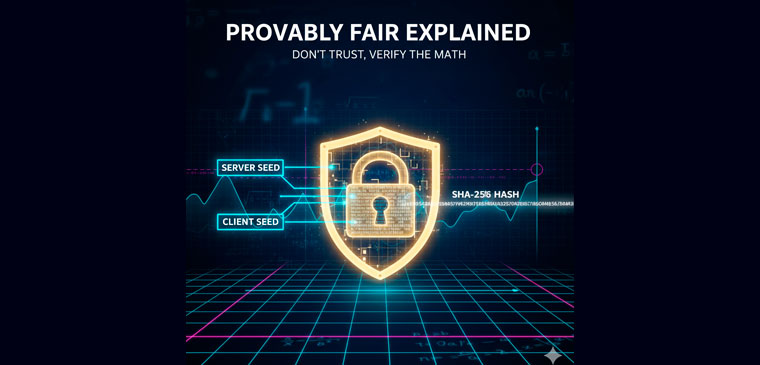
Every Provably Fair round uses three inputs to generate the game result. No single party — not the casino, not the player — controls all three.
| Component | What It Is | Who Controls It | When It’s Revealed |
|---|---|---|---|
| Server Seed | A random string generated by the casino | Casino | After the round (hash shown before) |
| Client Seed | A random string from your browser, or one you choose | Player | Set before the round starts |
| Nonce | A counter that increases by 1 with each bet | Automatic | Known in real time |
The casino can’t cheat because it commits to the server seed (via hash) before seeing your client seed. You can’t cheat because you never see the server seed until after the round. The nonce prevents the same seed combination from producing identical results across rounds.
The SHA-256 Hash: The Digital Fingerprint
SHA-256 is a one-way function. You can turn any input into a 64-character hash, but you can’t reverse it — you can’t figure out the input from the hash. This is the same algorithm that secures every Bitcoin transaction.
server_seed + client_seed + nonceSHA-256 →
a7f3b2c9d4e5f6... (64-character hash)→ Converted to: Crash point (e.g., 3.47x)
The casino publishes the hash of the server seed before you play. After the round, they reveal the actual server seed. If you hash it yourself and get the same result — the round was fair. If the hash doesn’t match, the casino altered the seed after the fact.
Step-by-Step: How to Verify a Crash Game Round
Here’s the exact process, using Aviator as an example. Most Provably Fair crash games follow the same pattern.
Provably Fair vs Certified RNG: What’s the Difference?
✅ Provably Fair
Trust model: Verify it yourself
How it works: Cryptographic commitment before each round
Verification: Any player, any time, any round
Used by: Spribe (Aviator), SmartSoft (JetX), BGaming
Weakness: Requires technical understanding to verify properly
🔒 Certified RNG
Trust model: Trust the lab’s certificate
How it works: Software tested periodically by independent lab
Verification: Players cannot verify individual rounds
Used by: Pragmatic Play (Spaceman), Evolution (Cash or Crash)
Weakness: Relies on periodic audits, not per-round proof
Neither system is inherently “better.” Certified RNG is the legal standard in most regulated markets and has worked reliably for decades. Provably Fair adds a layer of player-side verification that’s particularly valuable in crypto casinos, where regulatory oversight may be lighter.
The ideal setup? A game that has both — a regulatory certification plus Provably Fair verification. Spribe’s Aviator, for example, holds certificates from multiple labs while also offering full Provably Fair transparency.
Which Crash Games Are Actually Provably Fair?
Not every game that claims “fair” is Provably Fair in the cryptographic sense. Here’s what the major providers actually offer:
| Game | Provider | Provably Fair | Certified RNG | Verification Method |
|---|---|---|---|---|
| Aviator | Spribe | ✅ Yes | ✅ Yes | In-game widget + third-party check |
| JetX | SmartSoft | ✅ Yes | ✅ Yes | In-game widget |
| Crash | BGaming | ✅ Yes | ✅ Yes | Provably Fair widget with detailed seeds |
| Spaceman | Pragmatic Play | ❌ No | ✅ Yes | GLI certification only |
| Cash or Crash | Evolution | ❌ No | ✅ Yes | Regulatory license + certification |
| Thunder Crash | eGaming | ❌ No | ✅ Yes | Certification only |
| Crash Rocket | Various | ⚠️ Varies | ⚠️ Varies | Check individual platform |
→ For full reviews of each provider’s approach, see our crash game provider comparison.
Red Flags: How to Spot Fake “Provably Fair” Claims
Some platforms use “provably fair” as a marketing buzzword without actually implementing the cryptographic system. Watch for these warning signs:
No Pre-Round Hash
The core of Provably Fair is the commitment before you bet. If the game doesn’t show you a hashed server seed before the round starts, it’s not Provably Fair — regardless of what the website claims.
Built-In Verifier Only
If the only way to “verify” is through the casino’s own tool, and they don’t provide the raw seeds for independent checking, you’re trusting the verifier — not verifying anything. A legitimate Provably Fair game gives you the server seed, client seed, and nonce so you can run SHA-256 yourself.
Server Seed Never Changes
Server seeds should rotate periodically (many systems reveal and replace the seed after a set number of rounds). If the same server seed hash appears for thousands of rounds, it could indicate a static, non-random system.
Vague Documentation
Legitimate providers publish detailed technical documentation of their Provably Fair implementation. BGaming, for example, provides a complete walkthrough on their website with code examples. If a platform offers no documentation beyond “we use provably fair technology,” treat the claim with skepticism.
Limitations: What Provably Fair Doesn’t Guarantee
Provably Fair is powerful, but it has boundaries. Understanding them prevents false confidence.
It doesn’t change the odds. A provably fair game with 97% RTP still has a 3% house edge. The technology ensures the rules are followed; it doesn’t remove the casino’s mathematical advantage.
It doesn’t guarantee your funds are safe. A casino can run genuinely fair games while still refusing withdrawals, imposing unfair terms, or going bankrupt with your deposit. Provably Fair covers game integrity — not financial security. A proper license addresses the financial side.
It doesn’t prevent rigged RTP settings. If a casino configures a game to run at 94% RTP instead of 97%, each individual round is still “provably fair” — the algorithm works correctly. But the overall expected loss is higher. Provably Fair proves the process is honest, not that the parameters are favorable.
→ To understand how RTP and house edge affect your odds, see our guide on how crash game algorithms work.
Frequently Asked Questions
What does provably fair mean?
Provably fair is a cryptographic verification system that lets players independently check whether a casino game outcome was predetermined and not manipulated. It uses SHA-256 hashing — the same technology behind Bitcoin — to create a tamper-proof record of every round. If the casino tried to change the result after you bet, the math wouldn’t match.
Can casinos cheat on provably fair games?
A properly implemented Provably Fair system makes mid-round cheating mathematically impossible — any change to the server seed would produce a different hash, and players would detect the mismatch. However, a casino could use a flawed implementation or not actually publish the hash before the round. This is why it’s important to verify using an independent tool rather than the casino’s own verifier.
How do I verify a crash game result?
After a round ends, copy the server seed, client seed, and nonce from the game’s Provably Fair widget. Paste them into an independent SHA-256 hash calculator (not the casino’s own tool). Calculate the hash and compare it to the hash published before the round started. If they match, the result was not tampered with.
Is provably fair the same as RNG?
No. RNG (Random Number Generator) creates random outcomes but operates as a black box — you trust a certification lab. Provably Fair also uses randomness, but adds a cryptographic layer that lets players verify each round independently. Think of RNG as a sealed dice roll you trust happened fairly; Provably Fair is a dice roll you can watch happen and check the result.
Which crash games are provably fair?
Aviator (Spribe), JetX (SmartSoft Gaming), Crash (BGaming), and most crypto-native crash games use Provably Fair systems. Games like Spaceman (Pragmatic Play) and Cash or Crash (Evolution) use certified RNG instead — fair, but not independently verifiable by players. See our provider comparison for the full breakdown.
Does provably fair mean I’ll win more?
No. Provably Fair guarantees the game isn’t rigged — it does not change the odds, the house edge, or the RTP. A provably fair game with 97% RTP still returns $97 per $100 wagered long-term. The technology ensures the casino plays by the published rules; it doesn’t remove the mathematical advantage the casino has built into the game.