

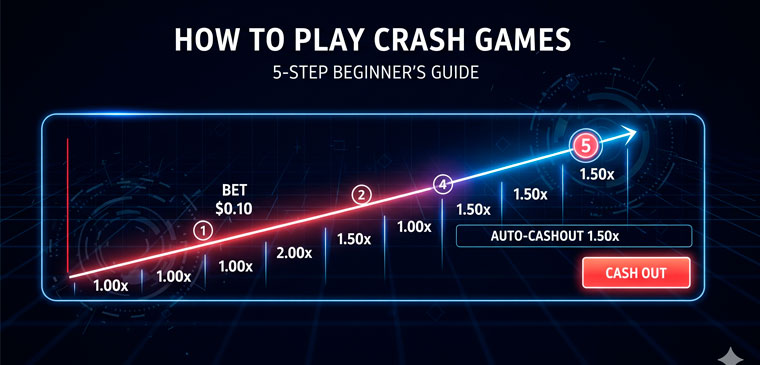
Crash games are the simplest casino games you’ll ever play. There are no cards to memorize, no paylines to track, no complex rules to learn. You bet, you watch a number go up, and you decide when to stop. That’s it.
But “simple” doesn’t mean there’s nothing to learn. The difference between draining your bankroll in 5 minutes and enjoying an hour of play comes down to understanding the interface, using auto-cashout, and managing your bets. This guide covers everything you need for your first session — and nothing you don’t.
What Is a Crash Game? The 20-Second Version
That’s the entire game. Every crash game — Aviator, JetX, Spaceman, or any other variant — follows this exact structure. The visuals change (planes, rockets, astronauts), but the mechanics are identical.
Rounds last 8-15 seconds. There’s almost no gap between rounds. You can play 100+ rounds in under 30 minutes, which is why bankroll management matters so much.
How to Play: 5 Steps From Zero to First Cashout
Choose Your Bet Amount
Before the round starts, set how much you want to wager. Most games accept $0.10 to $100 per bet. For your first session, use the minimum bet ($0.10-$0.50). You’re here to learn, not to win.
Some games (like Aviator and JetX) let you place two bets simultaneously with different cashout targets. Ignore this feature for now — stick to one bet until you’re comfortable.
Set Auto-Cashout (Recommended)
Before the round begins, you can set an auto-cashout target. For example, if you set it to 2.00x, the game will automatically cash you out when the multiplier hits 2x — even if you’re not watching.
Why use it: eliminates the risk of slow internet causing you to miss your target, and removes the temptation to “wait just a little more.” Set it to 1.50x for your first 10 rounds.
Watch the Round
The multiplier starts at 1.00x and climbs. On screen, you’ll see an animation — a plane ascending, a rocket launching, or a line graph going up. This is purely visual; the only number that matters is the multiplier.
The multiplier accelerates as it rises. Going from 1x to 2x takes a few seconds; going from 50x to 100x can happen in under a second. This speed creates the tension — and the mistakes.
Cash Out (or Let Auto-Cashout Do It)
If you’re playing manually, hit the Cash Out button whenever you want to lock in your winnings. Your payout = bet × multiplier at cashout. If you bet $1 and cash out at 3.00x, you receive $3 ($2 profit).
If you set auto-cashout, it happens automatically. You’ll see a confirmation on screen showing your winnings.
The Crash
At a random point, the game crashes. The plane flies away, the rocket explodes, or the line drops. Everyone who hasn’t cashed out loses their bet. There’s no partial payout — it’s all or nothing.
The crash point is decided by the algorithm before the round starts. It could be 1.00x (instant loss), 2.47x, or 847x. You can’t predict it, and past results don’t affect future rounds.
The Interface: What Every Button Does
All crash games share these core elements. Knowing where everything is before you play saves you from costly confusion mid-round.
| Element | What It Does | Where to Find It |
|---|---|---|
| Bet Amount | Sets how much you wager per round | Bottom of screen, usually with +/- buttons |
| Bet / Start Button | Confirms your bet for the upcoming round | Next to bet amount (changes to “Cash Out” during round) |
| Cash Out Button | Locks in your winnings during the round | Replaces the Bet button once the round starts |
| Auto-Cashout | Automatically cashes out at a multiplier you set | Toggle or field near the bet panel (labeled “Auto” or “Auto Cash Out”) |
| Auto-Bet | Repeats your bet automatically for multiple rounds | Usually a tab next to manual betting options |
| Live Multiplier | Shows the current multiplier in real time | Center of screen (large number) |
| Round History | Shows crash points from recent rounds | Top of screen or sidebar (row of colored numbers) |
| Live Bets | Shows other players’ bets and cashouts | Sidebar or bottom panel |
| Provably Fair / Info | Shows RTP, seeds, and verification data | “?” icon, shield icon, or game menu |
Your First Session: A 20-Round Plan
Beginner Session Blueprint ($5 total budget)
Rounds 1-5: Watch only. Don’t bet. Observe how fast the multiplier moves, when other players cash out, and how often the game crashes below 2x. Get a feel for the rhythm.
Rounds 6-10: Bet $0.25 per round with auto-cashout at 1.50x. You’re testing the mechanics. At this target, you’ll win about 65% of rounds. Five rounds × $0.25 = $1.25 risked.
Rounds 11-15: Bet $0.25 per round with auto-cashout at 2.00x. Now you’re in coin-flip territory (~49% win rate). Notice how losses come more often but wins pay more. Five rounds × $0.25 = $1.25 risked.
Rounds 16-20: Try manual cashout. Bet $0.25 and cash out whenever you feel right. Notice how much harder it is to click at the right moment, especially if the multiplier climbs fast. This is why auto-cashout exists.
Total budget used: $3.75 maximum. Lesson learned: You now understand the interface, the difference between auto and manual, and what different multiplier targets feel like.
The Numbers Behind Every Round
Crash games aren’t pure luck — there’s precise math under the surface. You don’t need to memorize it, but knowing these facts helps you make better decisions.
| Fact | What It Means for You |
|---|---|
| RTP is 96-99% (typically 97%) | For every $100 you bet total, expect to get ~$97 back. The $3 difference is the casino’s profit. |
| ~3% of rounds crash at 1.00x | About 1 in 33 rounds, everyone loses instantly. This is normal, not a glitch. |
| Each round is independent | Past results don’t influence the next round. 10 low crashes in a row doesn’t mean a big one is “due.” |
| The crash point is set before you bet | The casino can’t change the result based on your bet. Provably Fair games let you verify this. |
| Higher cashout = lower win rate | Targeting 2x wins ~49% of rounds. Targeting 10x wins ~10%. Your expected return is the same either way. |
→ For the full mathematical breakdown, including the formula and probability table, see our crash game algorithm guide.
Beginner Mistakes: What to Avoid in Your First Week
✅ Do This
- Use auto-cashout until you’re comfortable with the speed
- Start with minimum bets ($0.10-$0.50) — you’re learning, not earning
- Set a session budget before you open the game and stop when it’s gone
- Try demo mode first — same mechanics, zero risk
- Check the RTP in the game info before playing with real money
- Use one bet per round until you’re ready for dual-bet strategies
❌ Don’t Do This
- Don’t chase losses — doubling your bet after a loss leads to fast bankroll depletion
- Don’t look for patterns — each round is mathematically independent
- Don’t trust “predictor” apps — they’re all scams, no exceptions
- Don’t play every round — watch a few to reset your decision-making
- Don’t bet more than 2% of your bankroll per round as a beginner
- Don’t skip the demo — even 10 demo rounds teach you more than reading
Which Crash Game Should You Start With?
All crash games work the same way, but some are better for beginners than others.
| Game | Provider | Best For | Min Bet | Why Start Here |
|---|---|---|---|---|
| Aviator | Spribe | Most beginners | $0.10 | Largest community, best Provably Fair, dual bet for learning |
| JetX | SmartSoft | Players wanting higher max wins | $0.10 | Three simultaneous bets, unlimited multiplier |
| Spaceman | Pragmatic Play | Players at regulated casinos | $0.10 | Wide availability on licensed platforms, fun theme |
| Crash | BGaming | Math-focused players | $0.10 | 99% RTP (lowest house edge), Provably Fair, 1M max multiplier |
→ For detailed comparisons, see our Aviator alternatives guide and provider comparison.
What’s Next: After You’ve Played 50 Rounds
Once you’re comfortable with the mechanics, three things are worth learning:
1. How the algorithm works. Understanding the formula behind the crash point removes superstition and helps you think in probabilities instead of hunches. → Crash game algorithm explained
2. Provably Fair verification. If you’re playing with real money, learning to verify rounds ensures the game you’re playing is genuinely fair. → What is Provably Fair?
3. Strategy basics. No strategy beats the house edge, but understanding how variance works at different multiplier targets helps you play in a way that matches your risk tolerance. → Aviator strategy guide
Frequently Asked Questions
How do crash games work?
A crash game starts each round with a multiplier at 1.00x that rises rapidly. You place a bet before the round starts, then cash out whenever you choose. Your payout equals your bet times the multiplier at cashout. If the game crashes before you cash out, you lose your bet. The crash point is random and predetermined by the algorithm before each round. For details, see our algorithm guide.
What is the minimum bet in crash games?
Most crash games have a minimum bet of $0.10, making them accessible to any budget. Maximum bets typically range from $100 to $500 depending on the game and platform. Aviator accepts bets from $0.10 to $100 per round.
Can I play crash games for free?
Yes. Most crash games offer a demo mode that uses virtual currency. This lets you practice the mechanics and understand the interface without risking real money. The demo uses the same algorithm as the real-money version. We strongly recommend starting in demo mode.
What happens if I don’t cash out?
If the game crashes before you press the cashout button, you lose your entire bet for that round. There is no partial payout. This is why auto-cashout is recommended for beginners — it automatically secures your winnings at a target multiplier you set before the round.
Is crash gambling legal?
Crash games are legal in many jurisdictions where online gambling is regulated, including most of Canada, and many European countries. Legality depends on your location and the casino’s licensing. Always play on platforms with proper regulatory licenses. For specifics, see our crash gambling Canada guide.
Should I use manual or auto cashout?
For beginners, auto-cashout is strongly recommended. It removes the risk of internet latency causing you to miss your target and eliminates impulsive decisions during the round. Set a target multiplier (1.5x-2x is a good starting point), and the system cashes out automatically when it’s reached.