

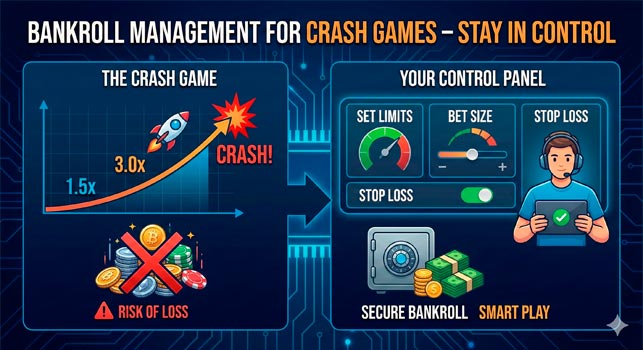
A crash game round takes 8-15 seconds. At $2 per bet, you can burn through $100 in under 10 minutes without a system. Bankroll management isn’t the exciting part of gambling — it’s the part that determines whether you play for 10 minutes or 2 hours. Every strategy, every multiplier target, every game choice becomes irrelevant if your bankroll hits zero before variance has a chance to work in your favor.
This guide gives you three things: a bet sizing table you can use immediately, hard rules for when to stop, and the math behind why flat betting outperforms every “double after loss” system.
The Core Rule: Your Bet Size Relative to Your Bankroll
Conservative (1%): $100 bankroll → $1 max bet
Moderate (2-3%): $100 bankroll → $2-3 max bet
Aggressive (5%): $100 bankroll → $5 max bet
The percentage you choose determines how many rounds you survive before going broke during a losing streak. At 1% bet size, you can survive 100 consecutive losses. At 5%, just 20. Since crash games at a 2x target produce losing streaks of 7-10 rounds regularly, this matters.
Bet Sizing Cheat Sheet
Use this table to find your bet size instantly. The stop-loss is set at 50% of your session budget — when you hit it, you stop.
| Session Budget | Conservative (1%) | Moderate (2-3%) | Aggressive (5%) | Stop-Loss (50%) | Min Rounds to Bust |
|---|---|---|---|---|---|
| $10 | $0.10 | $0.25 | $0.50 | Stop at $5 | 100 / 40 / 20 |
| $20 | $0.20 | $0.50 | $1.00 | Stop at $10 | 100 / 40 / 20 |
| $50 | $0.50 | $1.50 | $2.50 | Stop at $25 | 100 / 33 / 20 |
| $100 | $1.00 | $3.00 | $5.00 | Stop at $50 | 100 / 33 / 20 |
| $200 | $2.00 | $5.00 | $10.00 | Stop at $100 | 100 / 40 / 20 |
| $500 | $5.00 | $15.00 | $25.00 | Stop at $250 | 100 / 33 / 20 |
| $1,000 | $10.00 | $30.00 | $50.00 | Stop at $500 | 100 / 33 / 20 |
How to use it: Find your session budget in the left column. Pick your risk level. That’s your bet per round — no exceptions. The “Min Rounds to Bust” column shows how many consecutive losses it takes to hit zero at each level (conservative / moderate / aggressive).
Why Flat Betting Beats Martingale: A Concrete Example
The most dangerous advice in crash gaming: “double your bet after a loss.” Here’s what actually happens when two players face the same 5-loss streak.
❌ Player A: Martingale (double after loss)
Bankroll: $100. Target: 2x cashout.
Round 1: Bet $5 → Lose → Balance: $95
Round 2: Bet $10 → Lose → Balance: $85
Round 3: Bet $20 → Lose → Balance: $65
Round 4: Bet $40 → Lose → Balance: $25
Round 5: Bet $25 (all in) → Lose → Balance: $0
Result: Bankrupt in 5 rounds. Total play time: ~1 minute.
✅ Player B: Flat betting (2% per round)
Bankroll: $100. Target: 2x cashout. Bet: $2 fixed.
Round 1: Bet $2 → Lose → Balance: $98
Round 2: Bet $2 → Lose → Balance: $96
Round 3: Bet $2 → Lose → Balance: $94
Round 4: Bet $2 → Lose → Balance: $92
Round 5: Bet $2 → Lose → Balance: $90
Result: Lost $10. Still has $90 and 45+ rounds to play.
Player A’s approach works until it doesn’t — and when it doesn’t, it’s catastrophic. Player B’s approach is boring but survivable. At a 2x cashout target (~49% win rate), a 5-loss streak happens approximately once every 30 rounds. It’s not bad luck — it’s normal math.
→ For a detailed mathematical breakdown of why Martingale fails, see our Aviator strategy guide.
The Three Limits: Stop-Loss, Win Limit, Time Limit
A complete bankroll system has three exit triggers. When any one of them fires, you stop playing.
1. Stop-Loss: When to Walk Away from Losses
Why 50% and not lower? Because a 50% stop-loss gives you enough rounds to experience the game’s variance while preventing total loss. If you stop at 50%, you still have half your budget to try again another day. If you chase and play to zero, you have nothing.
2. Win Limit: When to Walk Away from Wins
The win limit is psychologically harder than the stop-loss. Nobody wants to stop winning. But the longer you play after a winning streak, the more your results regress to the 97% RTP average. Those profits will slowly evaporate over the next 200 rounds. Take them and leave.
3. Time Limit: When to Walk Away Regardless
Crash games are fast. At 10 seconds per round, you can play 360 rounds in an hour. Fatigue degrades decision-making — you start chasing, raising bets, abandoning your target. A time limit is a safety net against yourself.
Bankroll Management for Different Strategy Types
Your cashout target affects how you should size bets. Higher targets need smaller bets because losing streaks are longer.
| Strategy | Cashout Target | Win Rate | Avg Losing Streak (per 100 rounds) | Recommended Bet Size |
|---|---|---|---|---|
| Conservative | 1.5x | ~65% | 3-5 rounds | 2-3% of bankroll |
| Balanced | 2.0x | ~49% | 5-8 rounds | 1-2% of bankroll |
| Aggressive | 5.0x | ~19% | 10-15 rounds | 0.5-1% of bankroll |
| High-Risk | 10x+ | ~10% | 15-25 rounds | 0.5% max of bankroll |
Notice the pattern: the higher your target multiplier, the smaller your bet needs to be. A player targeting 10x at 2% bet size will regularly lose 20-30% of their bankroll before a single win. That’s not sustainable. Reducing to 0.5% makes the same strategy survivable.
→ For a full comparison of these strategies with expected P&L calculations, see our strategy guide.
Handling Wins: The “Lock Profit” System
Most crash game players have a profit management problem, not a loss management problem. They win $50, keep playing, and give it all back.
The Lock Profit system:
Step 1: When your session balance hits your win limit (e.g., +50%), immediately withdraw your original deposit. If you deposited $100 and you’re at $150, withdraw $100.
Step 2: Continue playing only with the $50 profit (“house money”). If you lose it, your net result for the session is $0 — you broke even, which is better than most sessions.
Step 3: If the house money doubles again ($50 → $100), repeat: withdraw $50 and continue with $50. This creates a ratcheting mechanism that locks in profits while still allowing play.
Common Bankroll Mistakes in Crash Games
Betting Without a Session Budget
If you open a crash game without deciding in advance how much you’re willing to lose, you’ve already failed. Set the number before you click “Bet.” Write it down if needed.
Raising Bets After Wins
Winning three rounds in a row doesn’t mean you’re “hot.” Each round is independent. Increasing your bet after wins (the Paroli system) has the same expected return as flat betting — but with higher variance. The extra variance comes at the cost of bigger drawdowns when the streak ends.
Not Counting Rounds
Crash games are so fast that players often don’t realize they’ve played 200 rounds. Use auto-bet’s round limit feature (available in most games) to enforce your session length automatically.
Ignoring the Game’s RTP
A 94% RTP game costs twice as much per session as a 97% RTP game. Checking the RTP before playing is part of bankroll management — you’re choosing how fast your bankroll depletes before you even place a bet.
Quick Reference: The 5 Rules
2. Set a 50% stop-loss before you start. Hit it → stop.
3. Set a 50% win limit. Hit it → withdraw original deposit.
4. Cap sessions at 50-100 rounds or 30-60 minutes.
5. Never increase bet size to chase losses. Ever.
→ Ready for full strategy? See our Aviator strategy guide or start with our beginner’s crash game guide. For the math behind crash points and odds, see how crash games work.
Frequently Asked Questions
What is the 1% rule in gambling?
The 1% rule means never betting more than 1% of your total bankroll on a single round. With a $100 bankroll, your maximum bet is $1. This protects you from variance and ensures your funds last for 100+ rounds even during a losing streak. It’s the safest approach for crash games, where rounds last only seconds and it’s easy to blow through a bankroll quickly.
Should I increase bets after a loss in crash games?
No. Increasing bets to chase losses (Martingale strategy) is dangerous in crash games. A 7-round losing streak at a 2x target requires 128× your initial bet, and these streaks occur approximately once every 100 rounds. Flat betting (keeping the same bet size) or even reducing bets during a cold streak is mathematically safer. See our strategy analysis for the full breakdown.
How much money do I need to start playing crash games?
Most crash games accept minimum bets of $0.10, so you can start with as little as $10 (giving you 100 rounds at minimum bet). We recommend at least $20 for a meaningful session. The key isn’t the deposit amount — it’s ensuring your bet size is 1-2% of whatever you deposit. Try free demo mode first to learn without risking anything.
What is a stop-loss in crash gambling?
A stop-loss is a predetermined loss limit for a session. When you hit it, you stop playing — no exceptions. We recommend a 50% stop-loss: if you deposit $100 for a session, stop when your balance reaches $50. This ensures you never lose your entire budget in one sitting.
How long should a crash game session last?
We recommend limiting sessions to 50-100 rounds or 30-60 minutes, whichever comes first. Crash games are fast (8-15 seconds per round), making it easy to play hundreds of rounds without noticing. Longer sessions increase fatigue and reduce decision quality.
Should I set a win limit as well as a stop-loss?
Yes. A win limit is just as important. If your $100 bankroll grows to $150, consider cashing out. The longer you play after a winning streak, the more likely your results regress toward the 97% RTP average — meaning you’ll give back your winnings over time.
What is the $20 method in crash games?
The $20 method is a session budget discipline adapted from slot machines: deposit a fixed amount ($20), play a set number of rounds at minimum bet, and walk away when the budget runs out — no reloading. For crash games at $0.20 per round, $20 gives you 100 rounds. At 97% RTP, expected cost is $0.60 (3% of $20). The method works not because of the dollar amount but because it enforces a hard stop. Apply the same principle with any budget: $10, $50, or $100. The rule is simple: decide before you play, never exceed it. See our strategy guide for approaches that work within any budget.