

Twist — Quick Facts
| Provider | InOut Games |
| Released | August 8, 2025 (Twist X-mas: December 2025) |
| RTP | 97% (3% house edge) |
| Cost/Hour ($1/bet, 80 rounds) | ~$2.40 |
| Volatility | High |
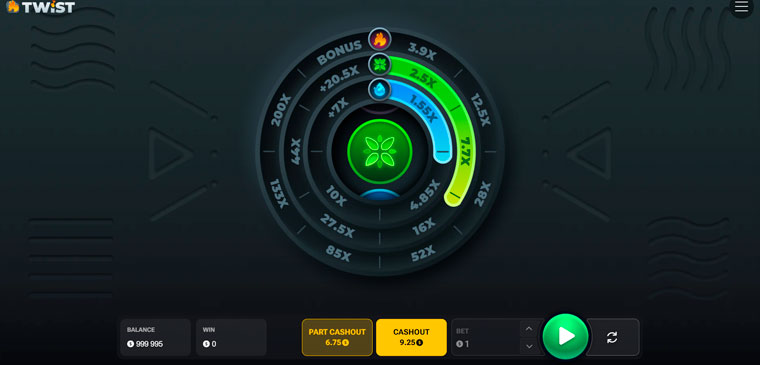
| Mechanic | Crash-slot hybrid — three elemental rings (Water/Earth/Fire) building multipliers independently via spins |
| Symbol Types | 5: Water, Earth, Fire (progress), Death/Skull (reset), Bonus |
| Part Cashout | ✅ Secure partial winnings while rings continue |
| Max Multiplier | x1,000 |
| Max Win | Up to $10,000 per round (per InOut; operator-dependent) |
| Bet Range | $0.01 – $10,000 (per InOut official; operator caps may apply) |
| Single Player | ✅ (no multiplayer lobby) |
| Provably Fair | ✅ (per InOut — provably fair RNG) |
| Variant | Twist X-mas (Christmas theme, same 97%) |
Twist is InOut Games’ elemental crash-style title — three rings (Water, Earth, Fire) build multipliers independently, a Death symbol resets progress, and Part Cashout lets you exit individual rings while others continue spinning. Released August 2025, it arrived before Squid Gamebler — and the similarity is obvious. Both games use the same triple-track mechanic with partial exits and a penalty symbol.
The difference that matters: this title has 97% return. Squid Gamebler has 94%. That’s 50% less house edge for the same fundamental mechanic.
Twist vs Squid Gamebler: Same Mechanic, Different Price
| Feature | Twist | Squid Gamebler |
|---|---|---|
| RTP | 97% | 94% |
| Cost/Hour ($1/bet) | $2.40 | $4.80 |
| Independent tracks | 3 (Water/Earth/Fire) | 3 (Circle/Triangle/Square) |
| Part Cashout | ✅ | ✅ |
| Penalty symbol | Death/Skull | Front Man |
| Max multiplier | x1,000 | x254 |
| Volatility | High | Medium |
This title wins on value across every mathematical dimension: 50% less house edge, 4x higher max multiplier, same Part Cashout, same triple-track structure. The competitor wins only on theme — the Netflix IP creates stronger recognition. But recognition costs you $2.40/hour extra.
Annual comparison: At $1/bet, 2 hours/week, this costs ~$250/year in expected losses. the alternative costs ~$499. The theme upgrade has a $249/year price tag.
How the Three Rings Work
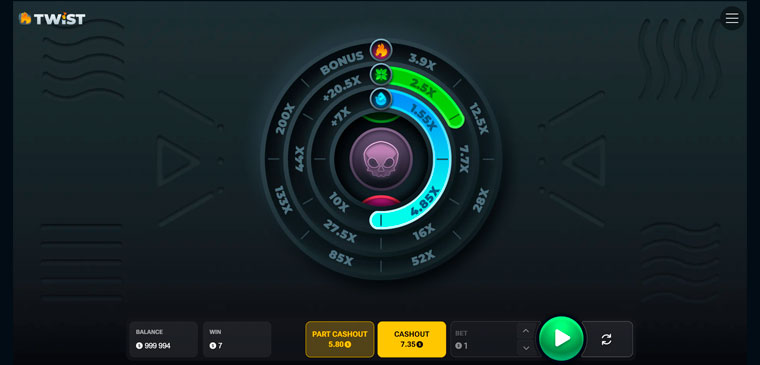
Each spin activates one of five symbols: three elemental symbols (Water, Earth, Fire) that advance their respective rings, a Death symbol that resets progress, or a bonus symbol. The rings build independently — Water can be nearly complete while Fire is just starting.
Completing a ring: When any ring fills completely, it triggers a bonus payout based on the accumulated multipliers in that ring. Each element has its own volatility profile — Water is steadier, Fire is the most volatile but highest-paying.
Death symbol: Resets ring progress — potentially erasing multiple spins of accumulated multipliers. This is the penalty that creates the core tension: every spin could advance a ring toward payout or destroy your progress.
Part Cashout: Lock in accumulated value from one or two rings while the third continues. Same portfolio-diversification mechanic as Squid Gamebler — but here you’re doing it at 97% instead of 94%. Bets can only be adjusted between rounds — once a round starts, you’re committed to the current stake.
The Bottom Line
This is the better-value version of InOut’s triple-track mechanic. Same three independent progress bars, same Part Cashout, same penalty symbol — but at 97% vs 94%. The fantasy elemental theme isn’t as commercially recognizable as Squid Game, but the math is undeniably better.
Within InOut’s portfolio, it sits at the same return tier as Aviator (97%). It costs half what Squid Gamebler charges for the same game structure. For multi-track games with partial exit decisions, this is the value pick.
⚠️ Responsible Gaming Note: The Asynchronous Trap: Three independent rings fill at different rates, so there is almost never a moment where all three are empty. If Fire is at 90% and Water is at 20%, you’ll keep spinning to finish Fire — but by the time it pays out, Water may be at 85%, locking you into a perpetual cycle where you’re always «too close» to a payout to walk away. This game never gives you a clean exit point. Set a hard monetary stop-loss or strict spin limit before starting. Part Cashout reduces individual round risk but doesn’t change the 3% house edge over time. If gambling is causing problems, contact GambleAware or the National Council on Problem Gambling.
Related Reviews & Guides
- Squid Gamebler Review — same mechanic, 94%, Netflix theme
- Chicken Road Review — same provider, 98%
- Aviator Review — standard rising-multiplier at same 97%
- Return Rate Comparison — all games ranked
- Session Cost Calculator — your exact hourly cost