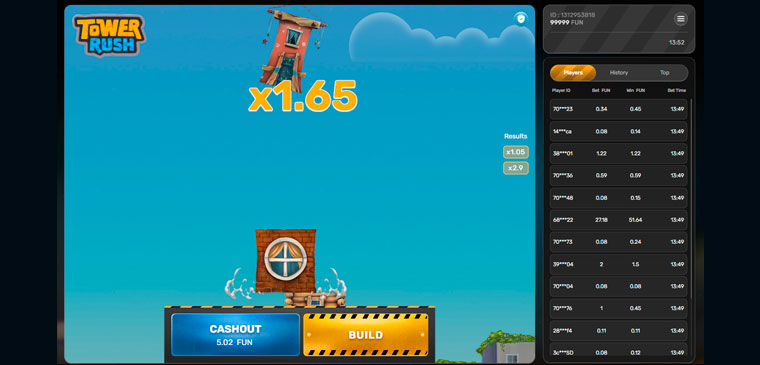
Tower Rush by Galaxsys uses a building sequence: a successful floor increases the accumulated multiplier, while continuing leaves the round exposed to collapse. The animation makes timing look important, but the visual presentation alone does not prove how much influence a player has over the result.
Published game specifications
| Item | Galaxsys listing |
|---|---|
| Release date | 28 February 2024 |
| RTP range | 96.2%–97.6% |
| Bonus floors | Frozen Floor, Temple Floor and Triple Build |
| Fairness description | “Provable Fairness” feature with an RNG explanation |
The public product card lists 96.2–97.6% RTP; the embedded demo rules state 96.17–97%. The ranges differ, so the installed game’s rules determine the applicable profile.
Source: Galaxsys’s Tower Rush page. It describes multiplication of successful floor values and a cash-out equal to the stake multiplied by the accumulated value.
Reading the accumulated multiplier
Multiplication differs from addition. For a purely illustrative sequence of 1.2 and 1.5, the combined multiplier is 1.8. A $10 stake cashed out at that value produces an $18 total return, including the stake: the net gain is $8.
This example explains the arithmetic only. It does not give the probability of either floor, predict the next placement or reproduce a Tower Rush pay table. Until the round is successfully collected, an indicated potential return is not the same as a completed payment.
Does better timing improve long-term return?
The demo rules state that the server determines outcomes. Crane animation and a successful sequence do not demonstrate that better timing raises RTP.
A measurable skill effect requires rules that explain how player input enters the outcome calculation. Without that relationship, visual precision cannot be translated into a probability advantage.
What the RTP range means
A theoretical RTP of 97.6% corresponds to a 2.4% edge; 96.2% corresponds to 3.8%. On a hypothetical $1,000 of turnover, those rates imply expected losses of $24 and $38 respectively. Turnover includes repeated wagers using previously returned money. These amounts are neither a session forecast nor a cap on possible loss.
A published range does not prove that players can select its upper endpoint. Check the installed game’s rules for the applicable return, limits and cash-out conditions. A statement about potentially unlimited floors would not, by itself, establish an unlimited monetary payout either.
How the bonus floors work
The Galaxsys demo rules say a bonus floor looks ordinary until it lands successfully.
| Floor | Effect | Limit |
|---|---|---|
| Frozen Floor | Locks in the accumulated return. A later collapse preserves that amount; cashing out a larger return pays the larger amount instead. | Once per round; no further bonuses follow it. |
| Temple Floor | One automatic wheel spin. Nine sectors multiply the current return by 1.5, 1.5, 2, 2, 3, 3, 5, 5 or 7; the tenth freezes it. | Can recur before freezing. Listed sectors do not establish their probabilities. |
| Triple Build | Automatically adds three floors, each with a multiplier of at least 1. | Can recur before freezing. |
A $10 stake frozen at 5x preserves $50 on a later collapse. Cashing out at 10x instead pays $100, not $150: the frozen amount is not added again.
Verification
Reproducing a completed result requires the relevant round inputs and the documented algorithm. Server-determined outcomes and a fairness label do not, by themselves, provide that calculation.
Related reading: Tower Rush in Russian, Boxes and the game directory.
Frequently asked questions
Does a larger displayed multiplier mean a collected win?
No. It describes an available or potential return. Collection has to be accepted before the relevant losing event.
Can awards establish a higher RTP?
No. RTP is a mathematical parameter of a game version. Awards and animation quality do not establish its value.